


Every January, the tech world descends on Las Vegas for the Consumer Electronics Show, where manufacturers often promise a cable-free utopia. This year was no exception. At CES 2026, brands on the show floor shared visions of a future without cords, cables, or clutter. LG unveiled its Sound Suite with Dolby Atmos FlexConnect, the world’s first soundbar system promising modular wireless flexibility. Samsung showcased its Music Studio speakers, designed to blend seamlessly into modern interiors. Both promised effortless sound, delivered through the ether. Yet a significant question lingers: where’s the power coming from?
We love the idea of freedom from wires—sound that fills the room without strings attached, literally. But the hi‑fi industry has been chasing that fantasy for decades, and the pursuit has become equal parts craft and comedy. “Wireless” has become a euphemism, a promise emblazoned across glossy ad campaigns but betrayed by the reality of electrons, amplifiers, and the inconvenient laws of physics. Let’s be honest: despite the slogans, the wireless revolution is largely cosmetic. Beneath every sculpted cabinet and fabric speaker grille lies the stubborn truth: we’ll always need wires.
The origins of “wireless”
Early in the 20th century, people referred to radio receivers as “wireless sets” or simply as “the wireless.” When families gathered around their living-room radios, they were listening to “the wireless.” It was a marvel because it made communication possible without visible links; voices and symphonies could leap invisibly across continents.
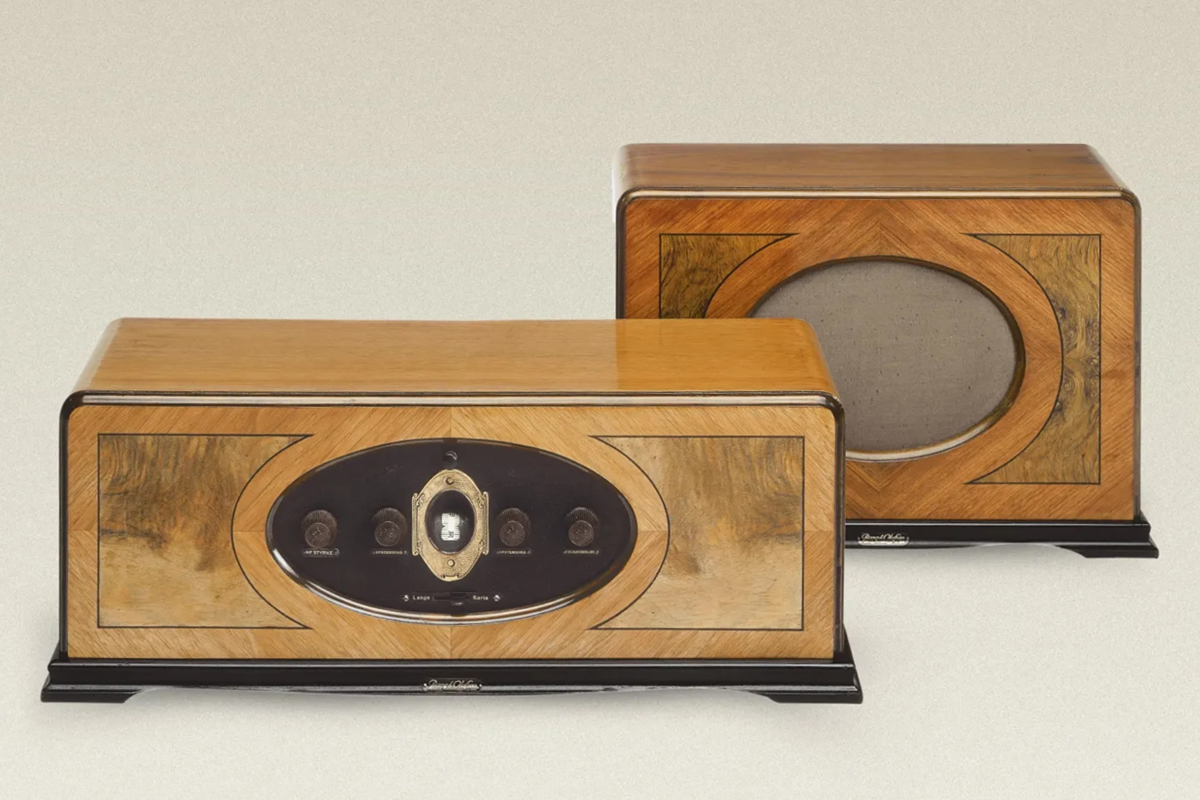
There’s an ironic footnote to this early history. According to the Bang & Olufsen website’s brand museum, the Danish company’s first mass-produced innovation was called “The Eliminator.” This device, introduced in the 1920s, allowed users to plug their battery-operated radios directly into the wall, which revolutionized radio technology at the time.
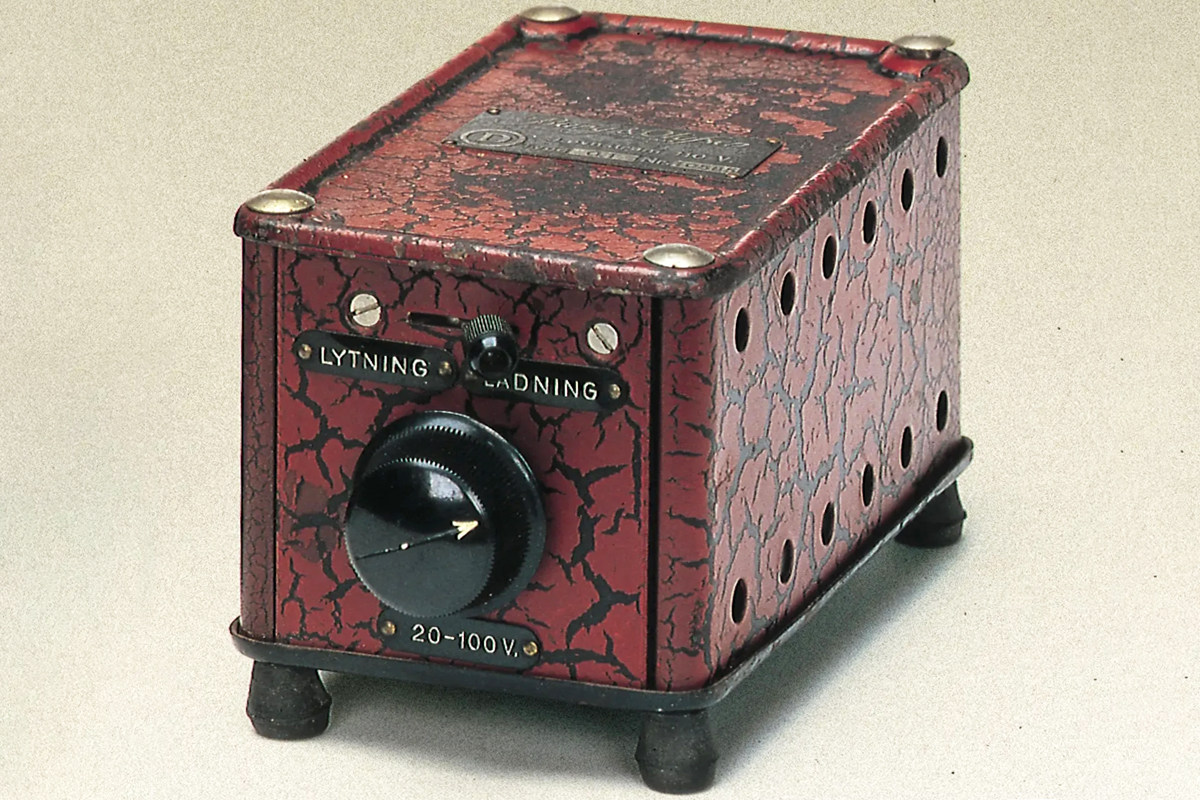
Peter Bang and Svend Olufsen went on to introduce their first successful mass-produced radio, “The Five Lamper,” in 1929. It could be plugged directly into an electrical outlet for a “steady, clean, uninterrupted experience.” In other words, Bang & Olufsen claim credit for taking an actually wireless audio product and turning it into a wired one. This seems like a strange boast, and perhaps a little ironic for a company that is now considered so design-forward, “rooted in Scandinavian minimalism.” But it speaks to a fundamental truth: back then, as now, wired power was the better solution.
From the 1960s onward, “radio” became the default term and “wireless” fell into disuse. Home audio came to signify wired systems: speakers connected to amplifiers or receivers via speaker wire, and to sources like turntables and tape decks with RCA interconnects. In home audio, the descriptor “wireless” reemerged with the introduction of infrared headphones and speakers in the 1980s and ’90s. These used IR transmission to send audio signals without cables. The technology was limited, requiring line-of-sight positioning and working only over a short range, but it reintroduced “wireless” as a selling point.
From the quadraphonic experiments of the 1970s to the Bluetooth boom of the 2010s, each generation of “wireless” audio technology promised the same thing: simplicity, minimalism, and liberation from tangled cords. But in the modern consumer-electronics era, wireless has taken on a more cosmetic meaning: not necessarily free of wires, just free of obvious, visible ones.
Today, “wireless audio” is a massive category encompassing everything from (actually) wireless earbuds to whole-home audio systems, representing a full circle back to audio transmission through the air, though with vastly improved technology over those original “wireless sets.” Yet practically every device that calls itself “wireless” still depends on cabled connections in one form or another.
Power requirements
As I’ve discussed before, when it comes to hi‑fi, loudspeakers either need to be wired to an amplifier’s output, or wired to a power source. For all our advances in streaming and Wi‑Fi connectivity, amplification remains stubbornly ruled over by the laws of electrical power combined with the inefficiencies of modern loudspeakers. To move air, you need power—and power demands current.
The physics of power delivery create a conflict between reality and marketing theater. Sonos, Bose, KEF, and countless others sell “wireless” systems that require at least one AC connection per device. They may connect to one another through Wi‑Fi or a proprietary radio-frequency protocol, but each cabinet has its own discreet umbilical line running to a power outlet, sometimes through the stand, sometimes along the baseboard, but always there.

Take the KEF LSX II, for instance. This compact speaker system, refreshed with new color options in late 2025, can stream lossless 24‑bit/192kHz audio over Wi-Fi. It connects to streaming services, supports AirPlay 2 and Google Cast, and pairs with other wireless speakers for multiroom audio. Yet each cabinet still requires a power cable. KEF’s LSX II LT, a more affordable variant introduced in 2024, simplifies things slightly by requiring only the primary speaker to be plugged into the mains, with the secondary speaker connecting to it via a proprietary USB‑C cable. But that’s still two wires minimum: one for power, one for inter-speaker communication.
Streaming via your phone to a system or linking the left and right channels over Wi‑Fi constitutes real wireless communication. Everything else, from amplification to transduction, still requires a material pathway for current and ground or an amplified audio signal. And with good reason. Electricity moves faster, cleaner, and with less loss through copper than through radiated power fields or resonant charging systems. Wires aren’t a flaw. They’re the best connection method we have.
But it seems that manufacturers, with their millimeter-perfect photos of setups that conceal every trace of the functional infrastructure, are attempting to hide that fact. The irony is that the more luxurious and minimalist the product line, the more elaborate the concealment becomes.
Staging perfection
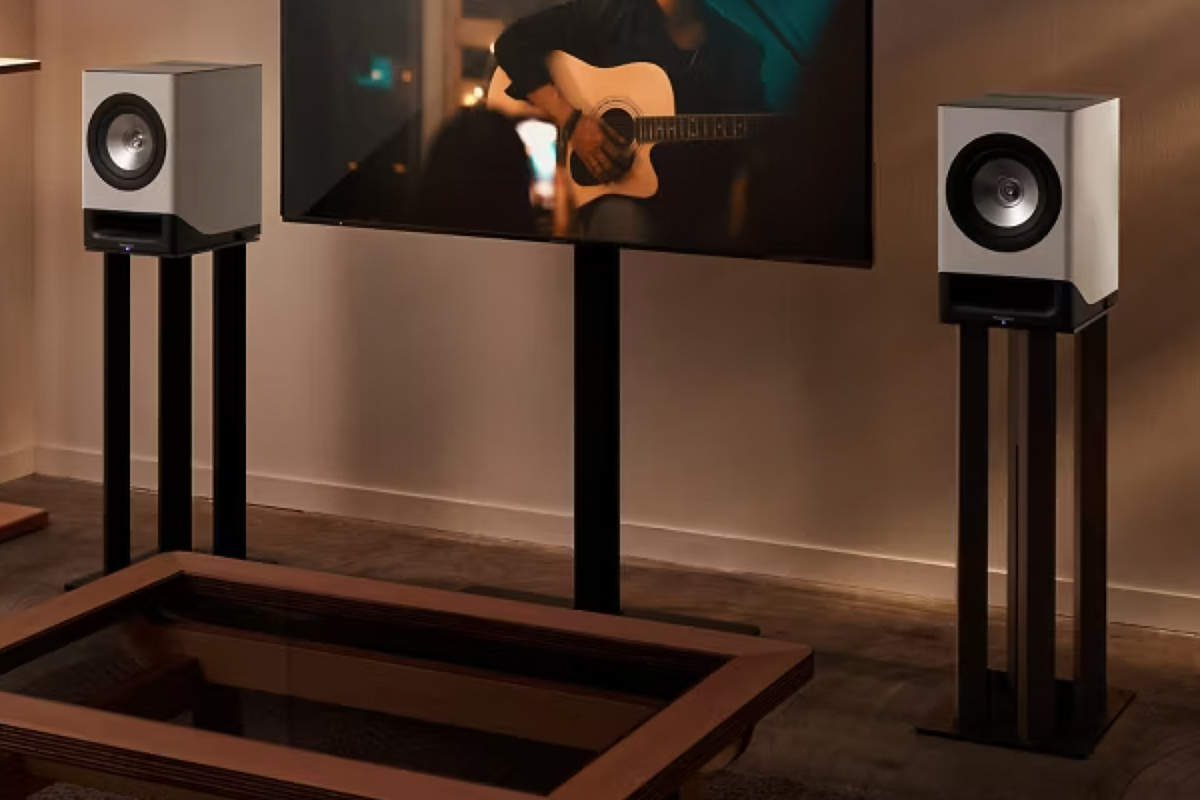
Modern hi-fi advertising is a study in concealment. The featured product shines in isolation: a sculptural piece in a tastefully bare living room, no cords, no clutter, only serenity. But real-world setups don’t look that way, because they can’t.
Here’s the weird part: there are many examples of product photographs found on actual hi-fi manufacturers’ websites that depict audio systems that could not possibly function as shown because there are no cables connecting things that need to be connected.

In some product photographs, there isn’t a single cable visible. Not one. The lower shelf where you might route cables? Empty. The area behind the equipment rack? Completely visible and completely cable-free. Nothing plugged in. There’s no speaker wire running to those beautiful standmounts, and there’s no power cable snaking to the wall. The amplifier is apparently powered by wishes and dreams. It all looks stunning, but these systems could never work as shown.
You might argue, “Maybe they’re just adept at hiding cables. Maybe everything runs behind the furniture.” But I’ve looked closely at shots where the area behind the equipment is clearly visible. I’ve seen promotional photos of speakers on stands, sitting in the middle of a room on a hardwood floor where any cable would be immediately obvious. These elaborately staged setups don’t have hidden cables—the cables aren’t there at all.
Car commercials don’t pretend that roads don’t exist. Sure, these ads are aspirational, but they’re not denying fundamental physical reality. The hi-fi industry, somehow, has convinced itself that cables are aesthetically incompatible with its systems. That the presence of cables in a photograph would somehow diminish the gravitas of the equipment. Customers about to drop five figures on a stereo system might be offended by the sight of a power cord.
There’s an obvious irony here: this same industry will turn around and try to sell you $500 (or $5000) cables for carrying the signal from the amp to the speaker, or for carrying power from the wall outlet to the amplifier. Cables are apparently so shameful, so aesthetically offensive, that they must be banished from product photographs. But also, cables are so vitally important that you should spend the equivalent of a month’s rent on them. The entire industry has created this bizarre doublethink where cables are simultaneously invisible in product photography, yet crucially important to system performance and worth spending absolutely stupid amounts of money on.
The obsession with spotless imagery trickles down to user expectations. Some people spend hours trying to achieve the impossible by drilling holes in walls, buying furniture intended to hide cables, and developing elaborate routing schemes that would make a network engineer jealous. The companies that fuel this neurosis are laughing all the way to the bank, selling the equipment and the expensive cable-management solutions and the premium cables that you’re supposed to hide because they’re too ugly to show but too important to cheap out on.
This has driven an entire accessory sub-industry: cord covers, floor conduits, cable raceways, and even smart power supplies designed for invisibility. Integration has replaced innovation as the frontier of high-end domestic audio, turning wire management into architecture.
Invisible infrastructure
There’s a deeper cultural dimension here, one that extends beyond hi‑fi. We’re living in an age of invisible infrastructure. Our phones exist because of networks of servers spanning continents. Our electric cars depend on vast power grids. Our cloud music libraries rely on fiber-optic cabling running under oceans. The wirelessness of modern life is an illusion built upon unprecedented quantities of wiring we simply never see.
High-end audio mirrors that contradiction perfectly. The cleaner the front of your system looks, the more elaborate its hidden connections tend to be. A “simple” wireless household speaker setup might involve a network of three routers to ensure solid connectivity throughout the home. A “minimalist” streaming system might hide a network switch, a NAS drive, a power conditioner, and multiple ethernet runs, all tucked away in a closet or basement, quietly maintaining the façade of simplicity. To experience “effortless sound,” you tap your phone, and music fills the room. What remains hidden is the disciplined infrastructure keeping that illusion alive.
Perhaps what we need isn’t better cable concealment. Perhaps we need more honesty. Imagine if a major hi‑fi manufacturer or magazine put out a product photograph showing the system exactly as it would actually exist in someone’s home. Show the rat’s nest of cables behind the rack. Show the power strip with 15 things plugged into it. Show the speaker cables running along the baseboard because fishing them through the wall would be too much trouble. Show the tangle of interconnects that you meant to organize but never quite got around to. Show that one cable that’s just slightly too short, stretched to its absolute limit. People might look at it and think, “Thank God, my setup looks like that too. I thought I was doing it wrong.”
The pragmatics of clean setup
Of course, this doesn’t make cable clutter any prettier. The true art of a satisfying hi‑fi space lies in managing the inevitable. The trick is in integration, in creating order that feels intentional. When installing a new system or component, treat wiring like an architectural feature. Power cords can live in paintable conduits that trace baseboards. Interconnects and ethernet runs can stay bundled in matching sleeves underneath shelving. Velcro ties, not zip ties, allow later adjustments without the stress of cutting and re-threading. Leaning into visibility rather than fighting it can work well. Using woven cables adds visual texture, a kind of industrial honesty that says: yes, this system lives.
There’s something strangely satisfying about that acceptance. Once you stop treating wires as intruders, you can admire them as part of the craft. Even the neat rows behind professional studio gear carry their own aesthetic—disciplined and purposeful.
When “true wireless” gets literal
Some brave companies have tried to prove the purists wrong, to banish every last cable from the audio chain. One such innovator is Trulli Audio, whose Bass50 subwoofer represents a genuine attempt at battery-powered high-power audio reproduction. It’s a self-contained, fully portable subwoofer capable of maintaining high-SPL output for several hours at a time. Using a 10″ ThinDriver that can handle 600W of continuous power, peaking at just over 1000W, it delivers output up to 122dB. The frequency range spans 20–225Hz, and the unit is powered by a rechargeable lithium iron phosphate battery. Priced at US$3899 for the carpeted version and US$4099 for a rugged outdoor version, it launched in mid-2025 as the world’s first premium battery-powered subwoofer.
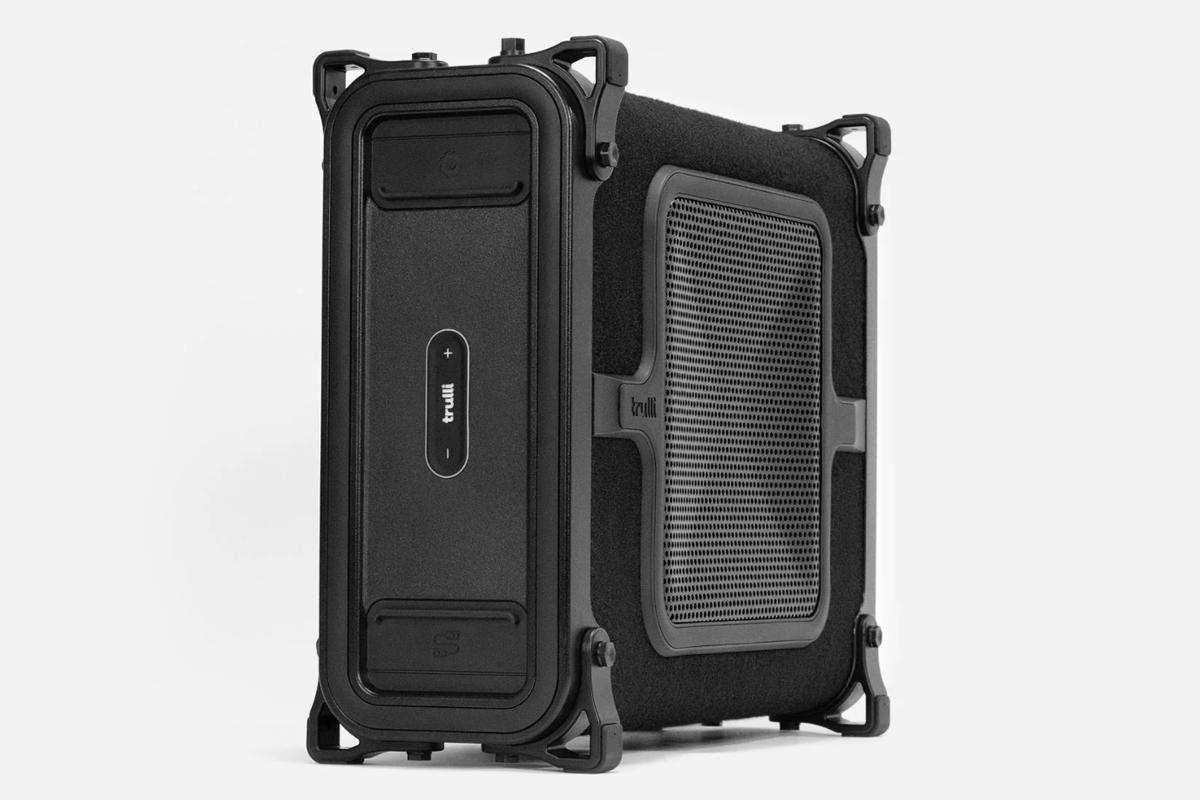
It’s a technological marvel—in theory. In practice, the novelty likely fades the third time you forget to charge it. True wireless operation at PA power levels demands enormous energy reserves. At high volumes, you’ll get seven to ten hours of use. At low levels, over 40 hours. But there are drawbacks. When multiple units discharge at slightly different rates in a multispeaker system, channel matching becomes inconsistent as voltage sags. The result is that most people, after the thrill of placement freedom fades, would end up keeping such “wireless” speakers plugged into an outlet anyway, which defeats the entire premise.
The lesson here is less about engineering limits than about user psychology. The public claims to want wireless hardware, until the maintenance burden shows up. Charging schedules, battery degradation, and lost runtime all feel more cumbersome than the simple act of running one well-hidden power cord. Convenience, it turns out, isn’t an absence of cables; it’s stability and reliability. It’s music that plays whenever you want, without a dead-battery warning blinking at you mid-chorus.
The future: beyond the illusion
Could the day come when we truly eliminate wires? Possibly, but it would require a fundamental shift in power infrastructure or in audio reproduction itself. Researchers have demonstrated wireless power-transfer technology. WiTricity’s magnetic-resonance technology can transfer up to 11kW for electric vehicles with over 90% efficiency, working through materials like asphalt and concrete. But here’s the problem: power level and distance. WiTricity focuses on EVs where you park directly over a charging pad. For home speakers, you’d need multiple high-power charging pads positioned precisely under each speaker. That’s expensive, impractical, and offers no real advantage over a simple AC cord. The technology would cost far more than just plugging speakers in.
The deeper question isn’t whether we can go wireless, but whether we really want to. Every advance toward concealment seems to distance us a bit from the sensory joy of sound. There’s something deeply satisfying about physically connecting equipment, knowing that your intention flows through tangible copper paths. In that mechanical handshake between amplifier and transducer lies a kind of trust that no wireless protocol can match.
The “wireless revolution” isn’t a rebellion against wiring. It’s a design exercise in hiding our dependence on it. Every smart speaker, every invisible soundbar, and every concept shown at CES masks that same infrastructure. Power cord required. The future of audio might be sleek, minimalist, and smarter than ever. But as long as amplifiers need power and physics refuses to bend, we’ll always need wires.
. . . AJ Wykes