


Note: for the full suite of measurements from the SoundStage! Audio-Electronics Lab, click this link.
Linn Products may be best known for its Sondek LP12 turntable, originally introduced in 1972, but the Scottish brand has been manufacturing its DS streaming components since 2007. Linn ceased production of optical disc players back in 2009. Its three Network Music Players (Linn’s terminology for streaming components) are currently the only digital source components that the company offers. The least-expensive model is the Majik DSM, the subject of this review. It includes amplification, so it can be thought of as a streaming integrated amplifier. The two other models, the Klimax DSM and Selekt DSM, require separate power amplification.
The 2025 iteration of the Majik DSM is the fifth version of this product and is priced relatively affordably (for Linn) at US$5950, CA$8085, £4299 (including VAT), or €4300 (sales taxes extra). In addition to extensive connectivity and Linn’s proprietary class‑D amplification technology, the Majik features the company’s Space Optimisation room-correction system.
Because Linn’s top-of-the-line DSM streamer, Sondek turntable, and active speaker system have eye-wateringly high prices, I was a bit surprised at the cost of the Majik, especially considering that similarly equipped streaming integrated amplifiers from some manufacturers cost much more. Given its relatively reasonable price, I was eager to hear how the fifth-generation Majik would perform in my system.
This is not an illusion
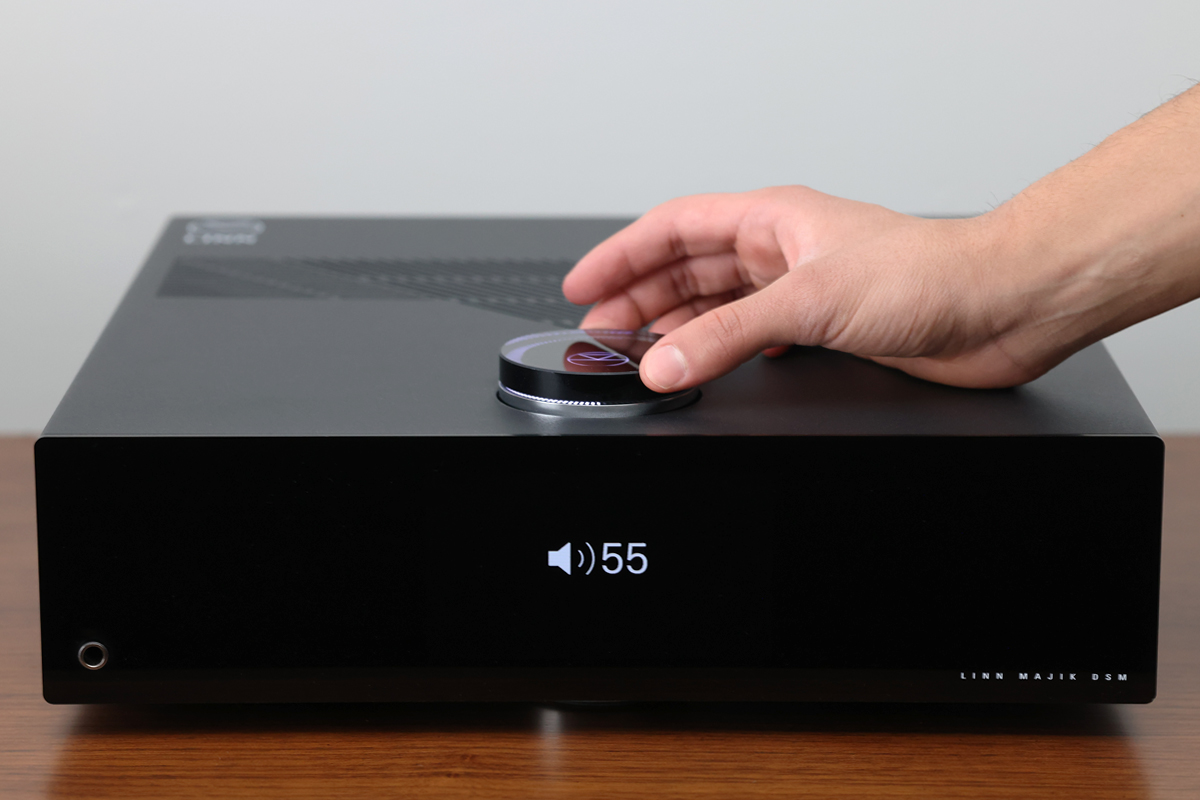
Based on its attractive appearance and impressive feature set, you could be excused for thinking the Majik costs much more than it does. Outwardly, it looks quite similar to the more-expensive DSM models, with a clear acrylic faceplate and an illuminated cut-glass control knob on its top panel giving it a streamlined, modern appearance.
It measures a relatively compact 4.5″H × 13.8″W × 13.8″D and weighs 12.6 pounds. The casework consists of 2mm-thick folded aluminum coated in a very fine powder-black paint. The top surface has diagonal and parallel cutout slits for ventilation and is dominated by the attractive multifunction knob, which not only controls volume but also provides access to many functions through the menu system.
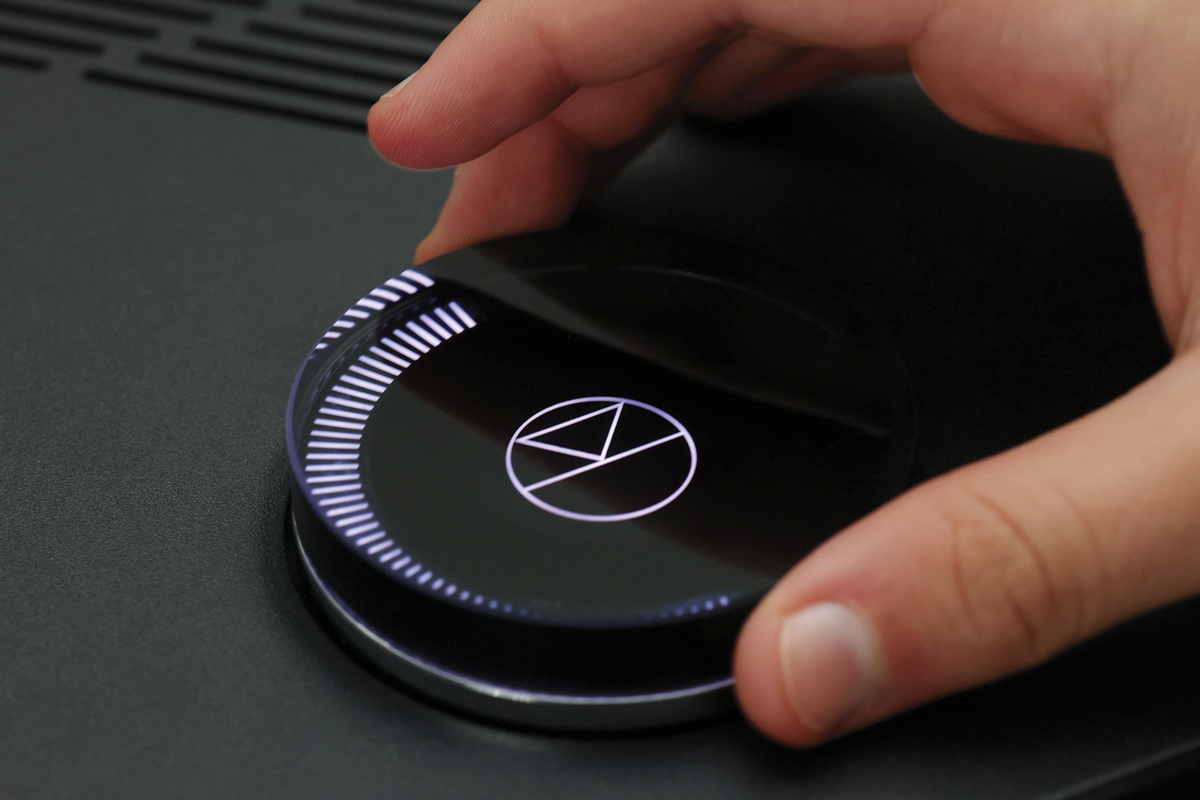
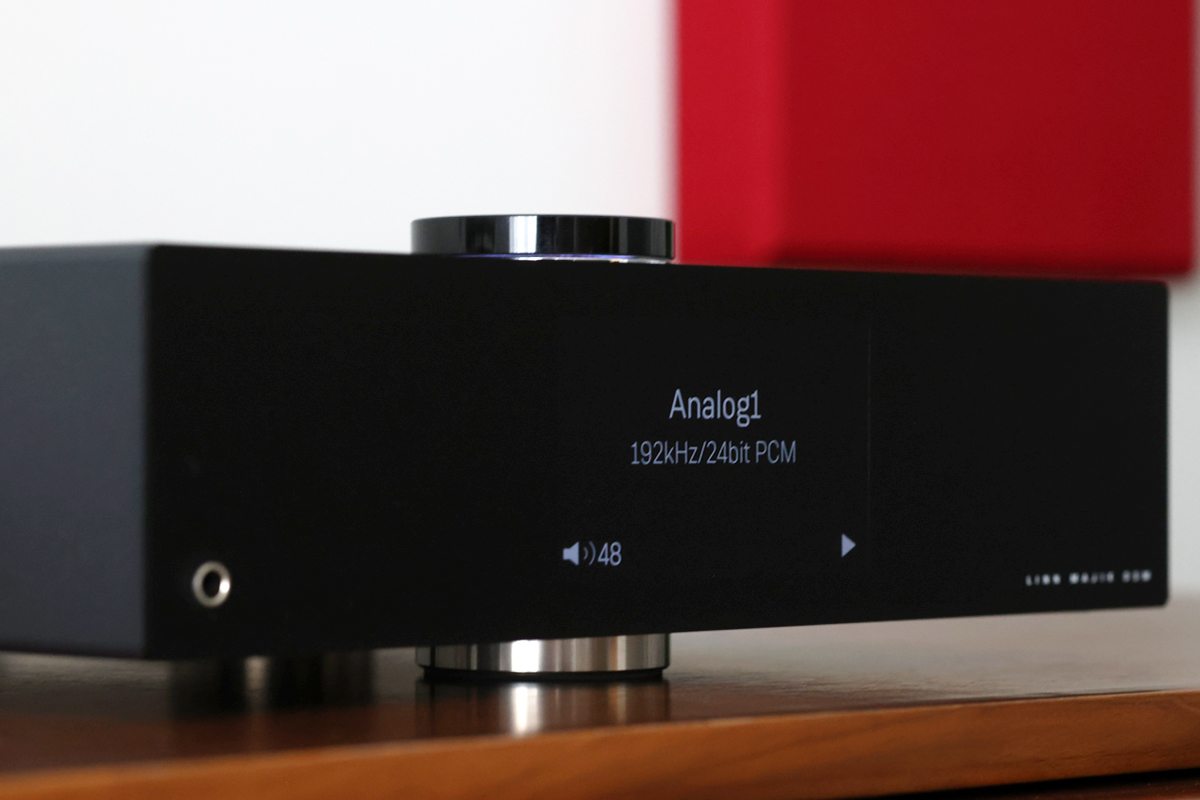
The clear acrylic panel covers the entirety of the unit’s front, but the centrally located monochrome display takes up about a third of that area. A 6.35mm (¼″) headphone output is located on the lower-left of the front panel, and the company and model name are screened onto the lower-right; the company’s logo is screened onto the back-left of the top panel.
The monochrome display is functional, if a little drab-looking when compared to some of the more colorful displays of the Majik’s competitors, but it provides legible text indicating the input, track information, volume (with volume displayed in a very large font momentarily when adjusted), and track progress with a status bar. The control knob indicates volume with a series of illuminated bars around its circumference, displaying different colors and levels of brightness when the unit changes operating status.
At its core, the Majik DSM is a high-quality streaming DAC utilizing proprietary precision clocking and upsampling, along with preamplification capabilities implemented in the digital domain prior to the DAC. The DAC section is said to be the same as the Selekt Standard DAC found in other Linn components. This is mated to an amplifier section rated at 50Wpc maximum into 8-ohm loads, doubling to 100Wpc maximum into 4 ohms. This section features an additional post-filter feedback loop, which is said to minimize distortion and improve efficiency.

The back panel is populated with high-quality speaker binding posts situated to the right, away from the other connections and slightly offset vertically for ease of connection. The RCA jacks arranged in a bank near the center of the panel are spaced a little closer together than I would have liked, but provide two sets of line-level inputs, stereo subwoofer outputs, and a line-level output. Separate MM and MC phono inputs are provided, as well as a grounding post. Digital inputs are situated to the left, comprising one coaxial (RCA) and one optical (TosLink) S/PDIF, USB‑C PC, and HDMI eARC.
The Majik DSM also has Wi‑Fi and Bluetooth 4.2 wireless connectivity. Via USB, ethernet, and Wi‑Fi, it can handle data streams of PCM up to 24-bit/384kHz and DSD256. Maximum resolution via S/PDIF is 24/192. In addition to DSD DSF and DFF, other supported file types include FLAC, WAV, MP3, AAC, AIFF/AIFC, ALAC, Ogg Vorbis, and WMA.
The coaxial input can be configured as an S/PDIF output without any volume control, but it does not support DSD. And because there is no digital signal processing on DSD, functions such as subwoofer crossover and Space Optimisation are also disabled for DSD signals. The Majik also performs A‑to‑D conversion at 24/192 for its analog inputs.

Control is accomplished with a slick new Linn app available for iOS or Android; a web-based interface for more extensive system configuration is also provided. Development of Linn’s previous Kazoo app ceased in 2023 when Tidal removed support for it. Linn has been at this a long time, so their software works well and is user-friendly. There is even extensive online documentation available in the LinnDocs section of the company’s website, which I found extremely informative and useful.
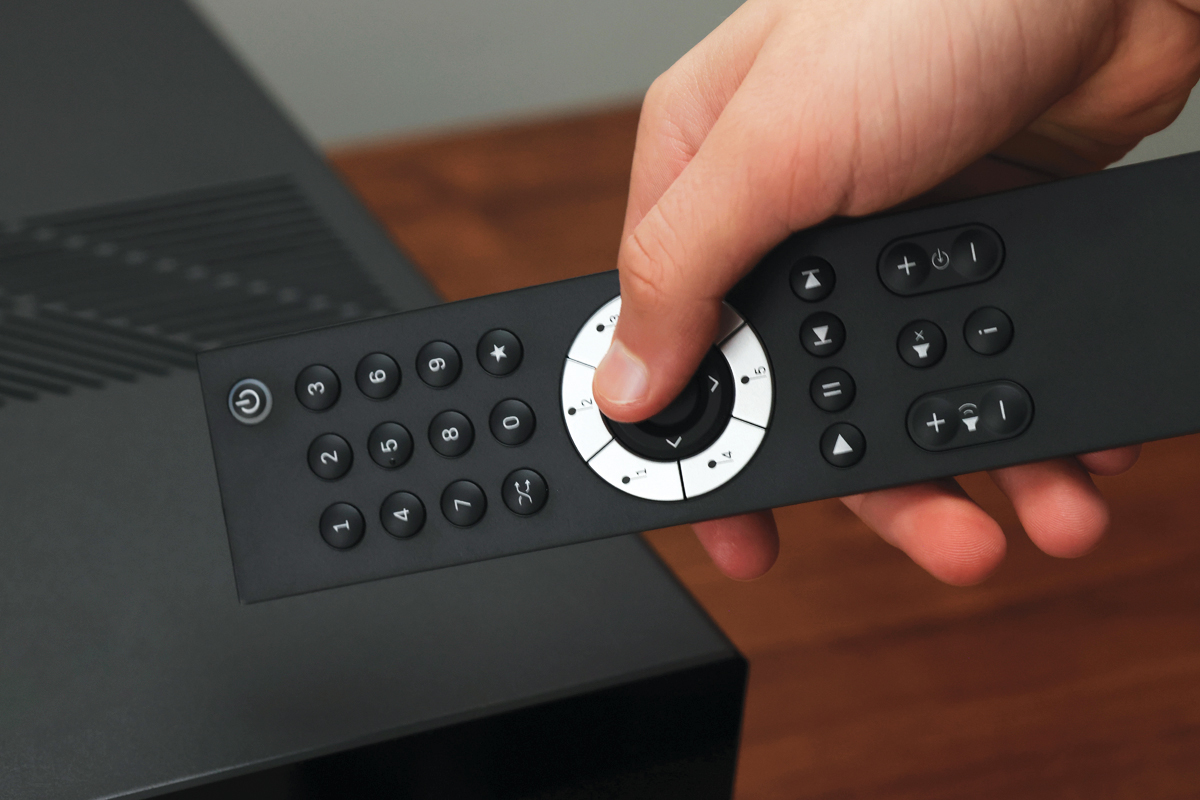
The Majik DSM can be controlled via the IR remote, the control knob, or, most easily, the excellent Android and iOS apps. The menu system is used to access inputs, update software, manage wireless connections, assign functions to the remote’s Star key, and tweak various settings such as lip-sync, balance, brightness, and headphone output mode. System configuration is achieved through the web-based interface, which connects to the user’s Linn account to adjust settings such as sources, streaming services, display options, output and volume modes—including subwoofer and crossover options—and, most importantly, to set up Space Optimisation.
The Majik is Roon Ready and supports Apple AirPlay 2 and Spotify Connect. The companion Linn app provides access to Tidal, Qobuz, airable, TuneIn, and Calm Radio. The phono stage has impedances of 47k ohms and 100 ohms, capacitances of 100pf and 470pf, and gain of 40dB and 54dB for MM and MC, respectively.
The subwoofer outputs can be configured as mono or stereo. Bass frequencies can be divided between the sub and main channels or augmented by the sub(s) below the crossover frequency with a full-range signal sent to the mains. The crossover frequency can be set to 60, 80, or 120Hz.
All Linn products are covered by a five-year warranty, as befitting high-quality specialty audio equipment, and it is even transferable between owners.
Preparing for the show
Basic setup and control are relatively straightforward using the web-based interface and app, but configuring Space Optimisation can be quite complex and is typically handled by a dealer. For this review, Linn brand ambassador and product trainer Paul Carlin, who was in town to visit Hi-Fi Centre, a local Linn dealer, dropped by my home to perform the Space Optimisation configuration. He carefully measured my room with a laser measuring tool, including the differing heights of the main listening area and the adjoining dining area and foyer, and the placement of the speakers in the room. He also input parameters specific to the construction of the walls and floors, and noted the location of any doors and windows. Finally, he added several settings for Space Optimisation’s balance of flat frequency response versus decay time. The differences between these settings were subtle, but the setting of 40/60 provided the best balance of detail and imaging while lending some warmth and weight to my room. In comparison, turning Space Optimisation off entirely resulted in a slightly smeared and indistinct presentation.
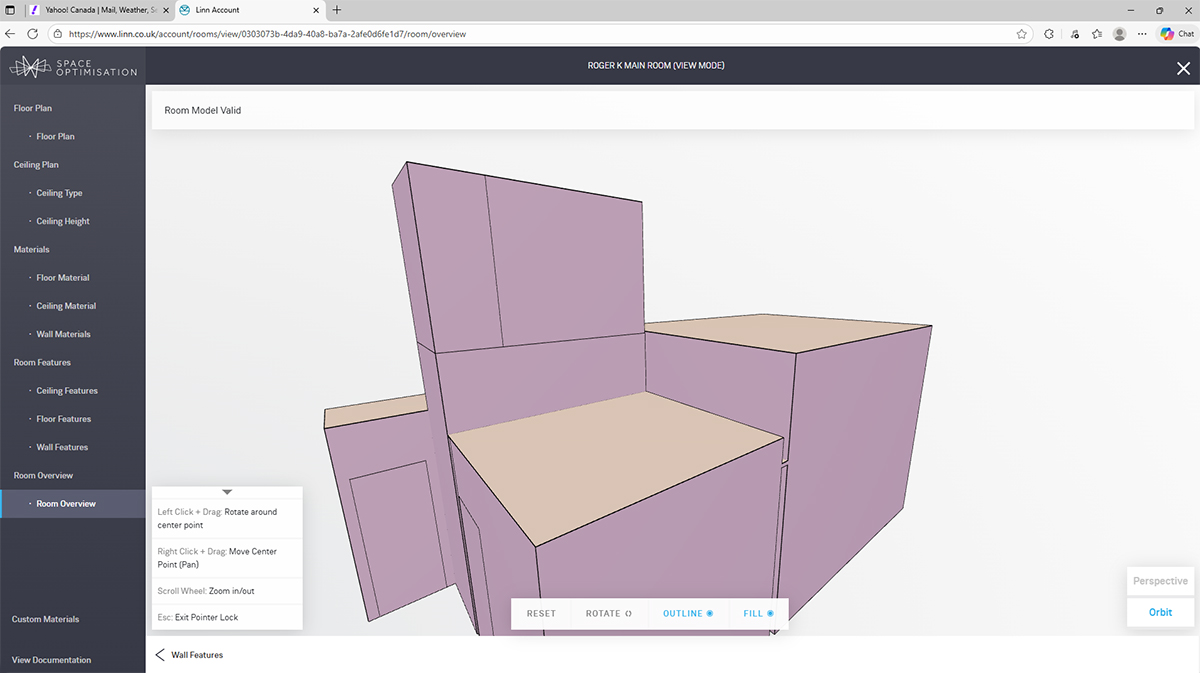
While setting up Space Optimisation can be somewhat complicated if a room has a lot of physical features, Linn believes that acoustic measurement with a microphone is prone to errors due to factors such as quality and calibration of the microphone and external noise. Thus, by modelling the room with a system such as Space Optimisation, these sources of error can be avoided. That may be true, but I have achieved very good results with acoustic-measurement-based systems such as RoomPerfect, Dirac Live, and ARC, even with very-high-resolution two-channel systems. In my experience, both types of room correction have merit.
As the Majik DSM is an all-in-one component, I needed only to add my MartinLogan Masterpiece Classic ESL 9 speakers and a Beelink mini PC as the main source, running Windows 11 and Roon and streaming Tidal and locally stored files. A Technics SL‑1500C turntable with Ortofon 2M Black cartridge served as the analog source. Interconnects and speaker cables were Analysis Plus Chocolate Oval‑In and Chocolate 12/2, respectively, and power cables were ESP MusicCord‑Pro ES; I used a generic Cat 6 cable for the ethernet connection to my router.
A magical performance
I no longer believe I have to describe the beneficial effects of room-correction systems in great detail in my reviews. High-end manufacturers such as Lyngdorf Audio and Anthem have been using proprietary room-correction systems in their products for many years, and Dirac Live has made significant inroads integrating such technology into high-end two-channel gear. It should be evident that room-correction systems work—and can work very well. This was my first time using Linn’s Space Optimisation, and the results were similar to what I have experienced with those other high-quality room-correction systems. The sound was more coherent overall, with tighter bass and better definition and imaging throughout the midrange. As such, I left Space Optimisation on for the entire time I had the Majik DSM in my system.

Even with its relatively modest power rating, the Majik was able to drive my ML ESL 9s to substantial volume levels playing Def Leppard’s Hysteria (Super Deluxe) (16‑bit/44.1kHz FLAC, Universal Music Catalog / Tidal). The drums on “Armageddon It (The Nuclear Mix)” had a deep, resonant quality without sounding boomy. Both the lead and rhythm electric guitars were absolutely ripping it up, while maintaining a clear distinction between their separate but complementary melodies. I heard similar things with “Pour Some Sugar on Me (Extended Version).” The massive drum whacks thundered but did not break, and the vocals had startling presence and realism.
Hysteria has a richer sound than its predecessor, Pyromania (Super Deluxe) (16/44.1 FLAC, Universal Music Catalog / Tidal), and this was quite evident with the Majik. “Photograph” is a big rocker from the band’s earlier album; while the vocals had a similarly lively quality, the drums were less resonant and drier in their presentation, and I could discern a slightly restrained quality to the electric bass. Overall, the bass on both albums was a tad lighter with the Majik than I am accustomed to. However, the clear, articulate sound and the ability of Space Optimisation to make everything seem perfectly balanced otherwise, even at high volumes, allowed the music to flow freely and individual instruments and vocals to really pop.
Playing Falco’s Falco 3 (Deluxe Version) (24/44.1 FLAC, Sony Music Catalog / Tidal), the original version of “Rock Me Amadeus” had a lush sound and a great sense of space. The “12″ American Edit” remix of the tune had more centrally focused vocals and instrumentation. The backing vox were spread hard to the left and right, but with little fill in the intermediate spaces and not much depth. However, with the more atmospheric “Blank & Jones so8os Reconstruction” remix, there was increased dimensionality to the echoey vocals and prodigious reverb of the synth. On the similarly elaborate “Vienna Calling (Tourist Version),” the Majik provided an immensely spacious quality. From the opening effects of voices over a PA to the background noise of city streets, these sounds were placed distinctly by the Linn player alongside the tight bass beat and a nearly solid wall of electronica.
Speaking of Vienna, my vinyl recordings of the Vienna Philharmonic Orchestra from Deutsche Grammophon’s The Original Source (TOS) series sounded dynamic and especially quiet through the Majik’s MM phono stage. The wide, orchestral sound of these remastered recordings was magnificent. “Confutatis” from Karl Böhm’s 1971 recording of Mozart’s Requiem (LP, Deutsche Grammophon 486 6720) opens with a dark, ominously powerful dirge followed by an ethereal combination of a women’s chorus and a perfectly delicate violin floating above the voices as if it’s descending from the heavens. The movement goes back and forth between these two extremes, and both were handled expertly by the Majik, which had no trouble in negotiating the extreme dynamic swings in the music.
Contemporary pop recordings with less dynamic range were no less enjoyable. The saxophone on Supertramp’s “The Logical Song” from Breakfast in America (LP, A&M 750 21 3708‑1) rocked with a lively vibrancy, and the slide whistle really jumped out at me from the speakers. While these were attention-grabbing, there was a relaxed and lovely sense of expanse and realism to the finger snaps and whistling on “Goodbye Stranger.”
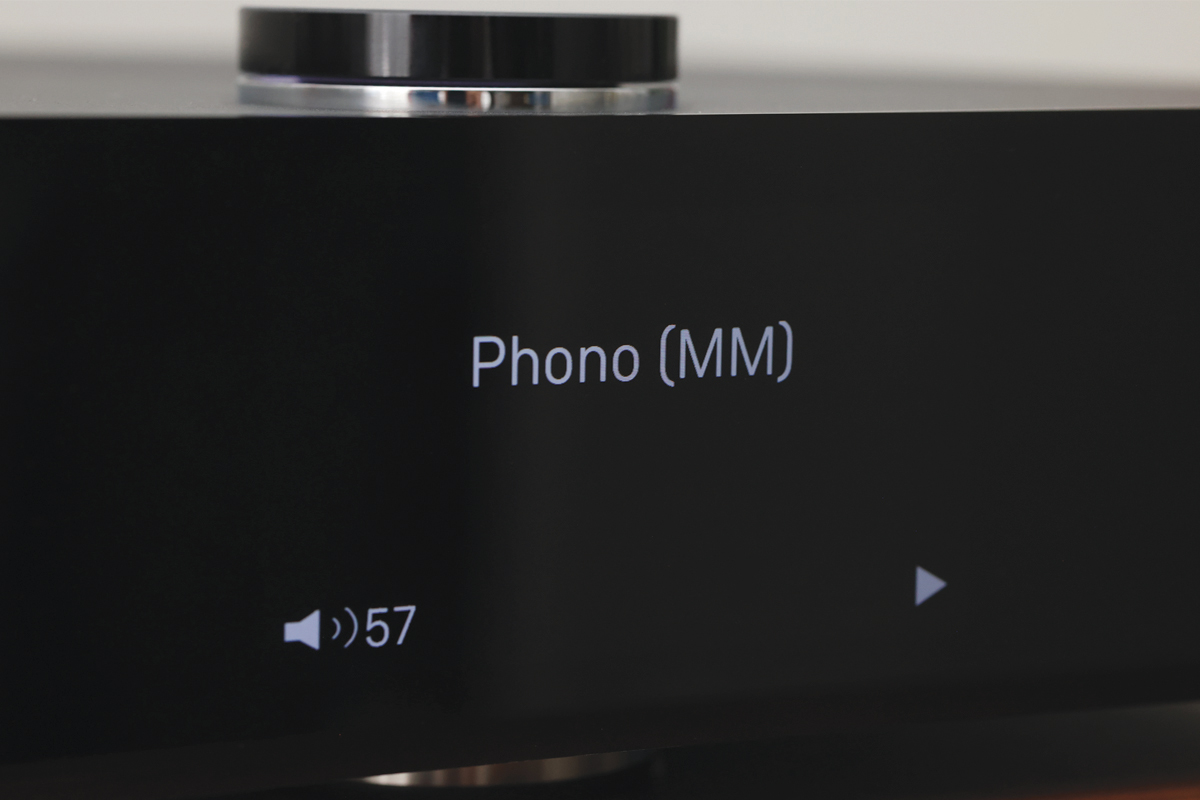
Fleetwood Mac’s Greatest Hits (LP, Warner 081227959357) also sounded very good, with a similarly refreshing effect, although slightly less soundstage depth and width. Neither of my copies of these two LPs is the greatest of pressings, but the Majik, along with the Technics SL‑1500C turntable and Ortofon 2M Black cartridge, minimized any noise and extracted a lot of detail from the less-than-pristine vinyl.
The phono section of the Majik compared favorably to my reference miniDSP ADept’s exceptionally clean and neutral sound. The miniDSP did exhibit a touch more sparkle in the highs, as well as additional depth and detail. The castanets at the opening of “The Logical Song” extended further out to the left, and the sax had a more lifelike bite. The miniDSP and the Linn sounded quite similar on tracks such as Fleetwood Mac’s “Rhiannon” or “Go Your Own Way,” where the soundstage is constrained to a smaller area between the speakers. I was extremely impressed by the Majik’s ability to play back all manner of vinyl records with aplomb.
With its capable phono stage, pristine digital streaming platform, effective Space Optimisation room-correction system, and high quality of amplification, I really wasn’t expecting much more from the Majik DSM. However, when I finally got around to listening with headphones—as I often do near the end of the review period—and cued up “Desert Rose,” from the deluxe release of Sting’s My Songs (24/44.1 FLAC, A&M-Interscope Records / Tidal), the Majik caught me off guard with surprising clarity and distinct imaging just slightly outside of my head and in front of me. It’s been a while since I’ve listened through the Bluesound Node Icon’s excellent THX AAA headphone output, but I would guess that the Majik’s headphone output is of similarly high quality. Indeed, the Majik was noticeably better at driving a pair of HiFiMan HE400se headphones than the built-in headphone output of my Oppo Digital UDP‑205 universal BD player. Electronic bass was weighty with the Oppo, but it was not able to reproduce the subtle textures of the bass’s sonic decay on “La Femme Chinoise,” from Yellow Magic Orchestra’s eponymous album (24/96 FLAC, Sony Music Direct (Japan) Inc. / Tidal), like the Majik could.

I did not have any other streaming integrated amplifiers on hand to compare directly to the Linn Majik DSM, but its combination of features, superb performance, and relatively reasonable price make it a seriously competitive product. The Majik’s 50Wpc into 8 ohms is surprisingly robust-sounding, and it has plenty of headroom—especially if its specification of 100Wpc into 4 ohms is to be believed. To drive large, inefficient speakers, I’d probably opt for the NAD Masters M33, but that amplifier now retails for US$7199. The Majik should suffice for most speakers that it would realistically be paired with. I could mention many other excellent-sounding integrated amplifiers in this price range that I have reviewed in recent years, but the Majik is one of only a very few to combine that high level of performance with a capable streaming platform and effective DSP.
Taking a curtain call
I didn’t know quite what to expect when I received the Linn Majik DSM for review, but I was thoroughly impressed by the first-rate execution of this product. In addition to its outstanding build quality and sonics, the app and web-based interface all worked flawlessly and intuitively. This made for an enjoyable user experience, something that is not always a given, even at this price point. Many will think that US$5950 is a lot of money for a streaming music player—and it is—but in the case of the Majik, the price is more than warranted.
. . . Roger Kanno
Note: for the full suite of measurements from the SoundStage! Audio-Electronics Lab, click this link.
Associated Equipment
- Loudpeakers: MartinLogan Masterpiece Classic ESL 9
- Surround-sound processor: Lyngdorf Audio MP‑40 2.1
- Power amplifier: Lyngdorf Audio MXA‑8400
- Digital sources: Beelink mini PC running Windows 11, Roon, and Tidal; Samsung Galaxy S21 smartphone, Oppo Digital UDP-205 4K Ultra HD universal BD player
- Analog source: Technics SL‑1500C turntable with Ortofon 2M Black cartridge
- Phono preamplifier-ADC: miniDSP ADept
- Headphones: HiFiMan HE400se
- Speaker cables: Analysis Plus Chocolate Oval 12/2
- RCA and XLR interconnects: Analysis Plus Chocolate Oval-In
- Power cords: Clarus Cable Aqua, Essential Sound Products MusicCord‑Pro ES
- Power conditioners: Blue Circle Audio PLC Thingee FX-2 with X0e low-frequency filter module, ZeroSurge 1MOD15WI
Linn Majik DSM streaming integrated amplifier
Price: US$5950, CA$8085, £4300 (including VAT), €4300 (excluding tax)
Warranty: Five years, parts and labor
Linn Products Limited
Glasgow Road
Waterfoot
Glasgow G76 0EQ
United Kingdom
Website: www.linn.co.uk