


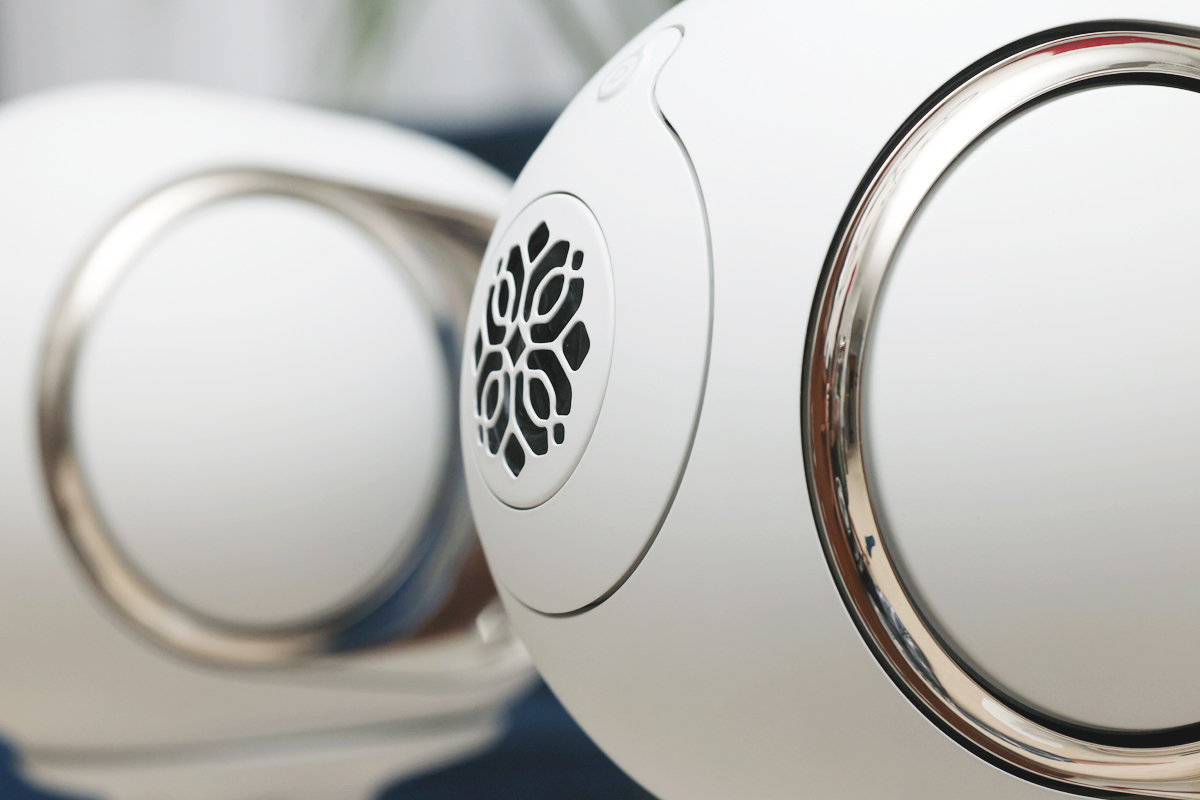
 I’ve been curious about Devialet’s Phantom line of all-in-one wireless active loudspeakers ever since they first launched in 2015. The French company made bold claims about their technology, their engineering, and their willingness to reimagine what a speaker could be. So when the opportunity arose to review the latest iteration of the Phantom, the Phantom Ultimate, I jumped at it.
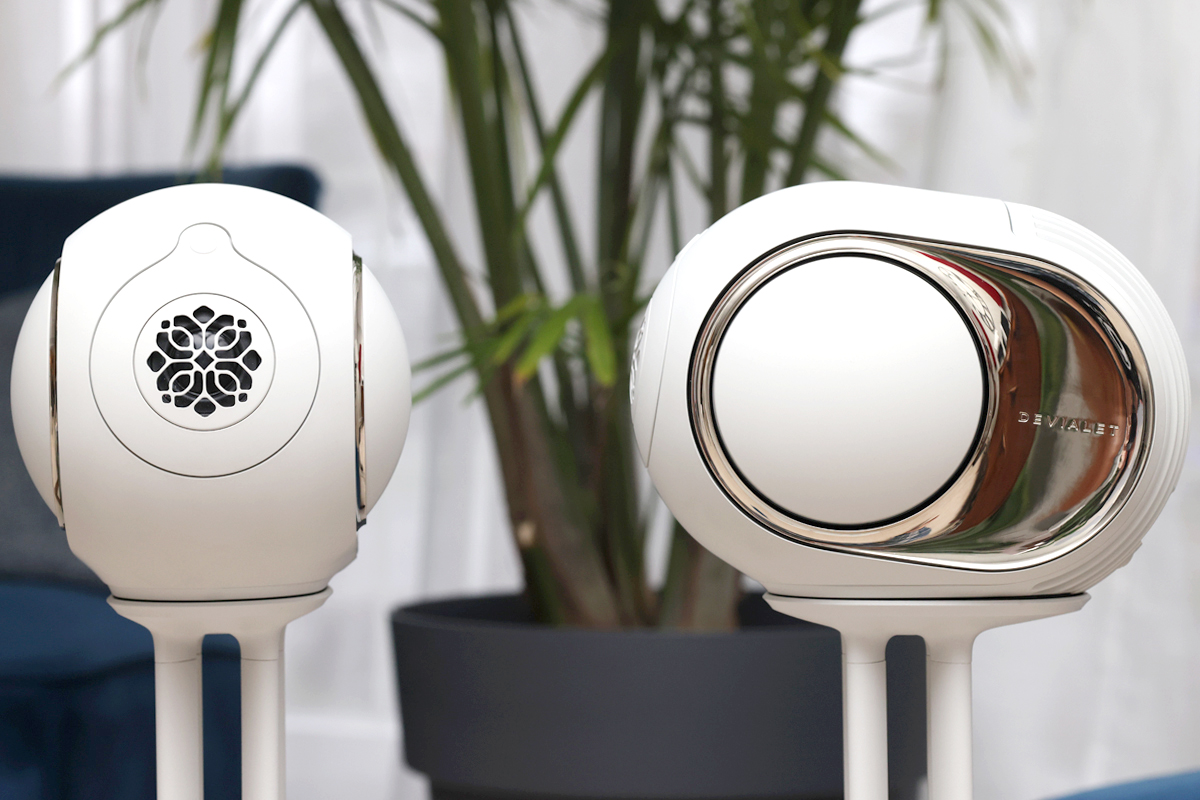
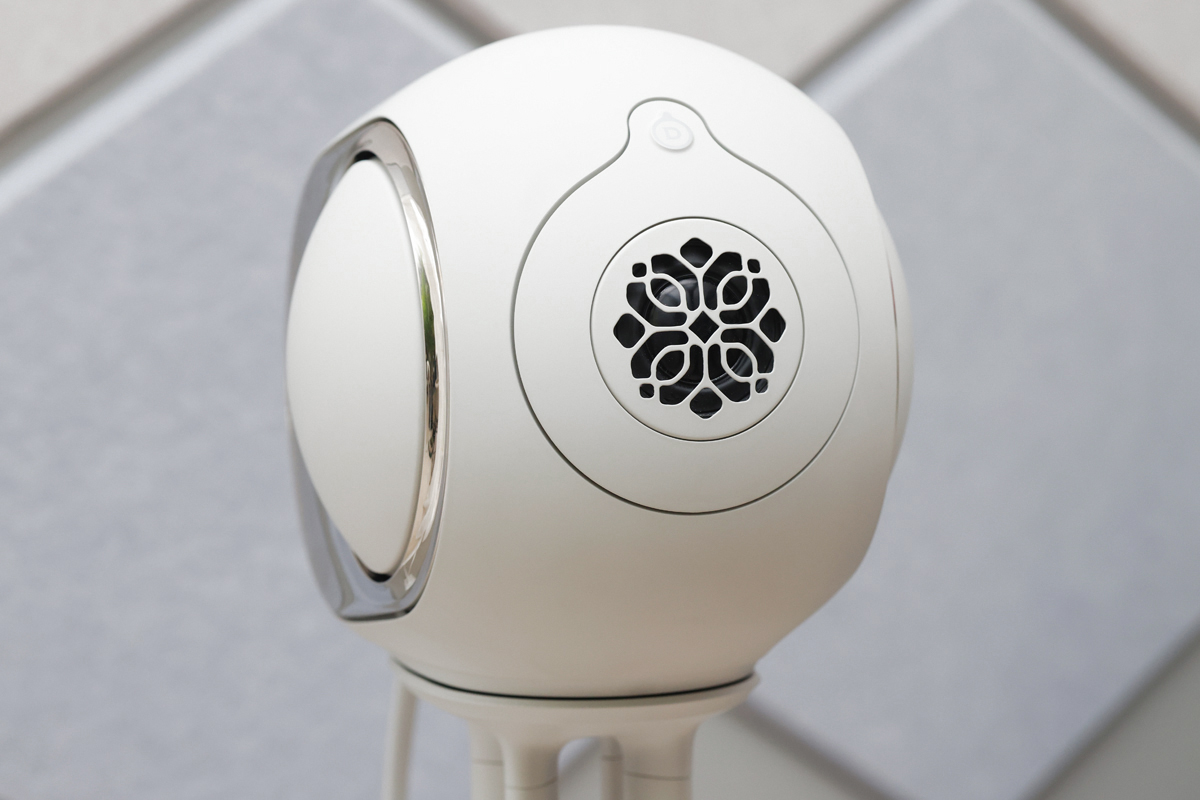
There are two versions of the Phantom Ultimate. Like previous releases, the Phantom Ultimate 98 dB and Ultimate 108 dB pack streaming capabilities, digital-to-analog conversion, amplification, and multiple drivers into an ovoid enclosure that looks like it was designed by someone who had never seen a loudspeaker before. Like a retro-futuristic objet d’art that happens to make sound, these Devialets make you question whether speakers have to take the form of rectangular boxes.
As the model names imply, a key difference between the two new models is maximum output. The Phantom Ultimate 98 dB is a two-way system with 400W of built-in amplification. Specified maximum SPL is 98dB at 1m. It costs US$1900, CA$2400, £1400, or €1500 per unit in the standard Light Pearl and Deep Forest finishes. For ostentatious tastes, there’s a fancy Opéra de Paris version (US$2400, CA$2700, £1650, or €1700 each) with the Paris Opera logo etched onto gold-leaf side plates.
The Phantom Ultimate 108 dB is a three-way system with 1100W of built-in amplification and maximum SPL of 108dB. Prices are US$3800, CA$4900, £2800, or €3200 each for standard finishes; and US$4300, CA$5400, £3300, or €3800 each for the Opéra de Paris version.
I reasoned that the 98dB model would be more than adequate for my listening environment, and questioned whether I’d be able to fully test the capabilities of the 108dB model without getting evicted. I think I made the right call. From this point forward, when I talk about the Devialet Phantom, I’m referring to the Phantom Ultimate 98 dB, the subject of this review.
Devialet sells its speakers individually, and this might give the impression that operating them singly is a valid option. It’s important to note, though, that unlike some smart speakers that can provide a convincing simulation of stereo using multiple tweeters and DSP enhancement, the Phantoms do no such thing, and operating them individually will only provide mono playback. For this reason, I opted to review a stereo pair, complete with their matching stands.
Inside and out
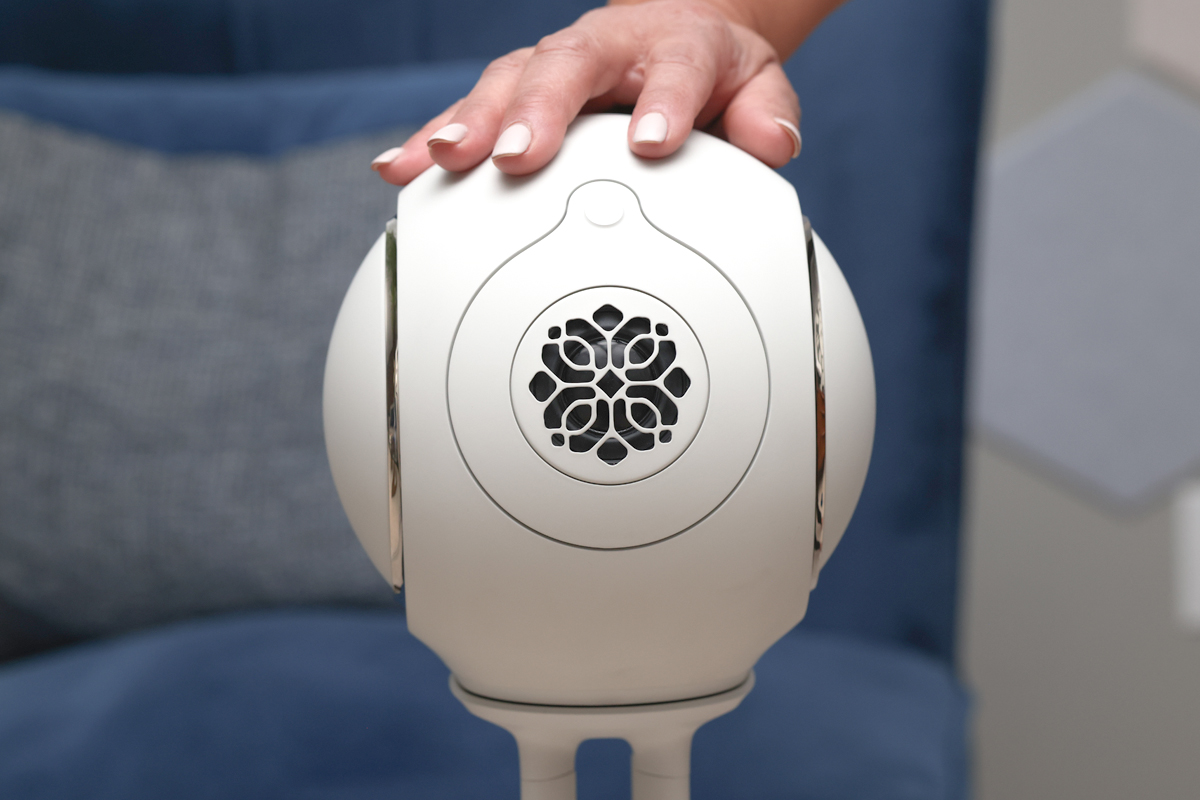
Unpacking the speakers from their shipping boxes, I found each one ensconced in a molded polystyrene nest, wrapped in a black fabric sock to protect the speaker from the ingress of loose particles. However, lifting one out, it became clear that care must still be taken to avoid touching the distinctive dome-shaped, side-mounted woofers when holding the unit, since their sturdy aluminum diaphragms are completely exposed. The speakers certainly feel robust; they’re very dense at 9.5 pounds apiece, and are approximately the size of a human head. To put it another way, each speaker measures just 6.6″H × 6.2″W × 8.6″D.
That compact enclosure houses an ambitious complement of technology: one front-firing “full-range” (Devialet’s description) aluminum-dome driver flanked by the two 4.5″ side-firing aluminum-dome woofers, which are crossed over to the front driver at 525Hz, all powered by a total of 400W of amplification. Frequency response is specified as 18Hz–25kHz, ±6dB. As noted, maximum SPL is rated at 98dB for a single unit; for a stereo pair, it’s 101dB.
The speakers integrate Devialet’s suite of proprietary technologies, each with its own three-letter initialism: ADH (Analog Digital Hybrid) amplification, SAM (Speaker Active Matching), HBI (Heart Bass Implosion) architecture, and ACE (Active Cospherical Engine).
ADH (Analog Digital Hybrid) technology combines class-A and class-D amplification for power and efficiency. This new generation of Phantoms features predictive control that anticipates speaker behavior in real time, reducing distortion and extending high-frequency response.
SAM (Speaker Active Matching) uses a real-time DSP mathematical model of the speaker system to control displacement with precision. This enables the compact speaker to produce bass that extends beyond what its size would normally allow, while also improving transient response and imaging.
The HBI (Heart Bass Implosion) mechanical architecture enables high bass output from a tiny three-liter internal volume per woofer. It incorporates custom shallow-profile woofers in a symmetrical push-push configuration, an aluminum central frame for heat dissipation, and a composite enclosure designed to withstand enormous internal pressure.
The ACE (Active Cospherical Engine) is a spherical acoustic architecture that eliminates diffraction effects and provides wide, consistent dispersion. Drivers are positioned in continuity with the spherical enclosure’s envelope.
As discussed, the design appears thoroughly unconventional for a loudspeaker. However, it serves acoustic purposes beyond mere aesthetics. The almost-spherical, symmetrical enclosure is actually an impressively neat solution that solves a number of acoustic challenges (standing waves, edge diffraction, baffle step, group delay) while getting as close to a theoretical point source as is feasible, leveraging everything that a fully active digital loudspeaker can bring to the table in terms of size, output, and bandwidth. It shares a lot of its acoustic philosophy with the KEF Blade but is much, much more compact. It’s actually closer to the platonic ideal of a pulsating, spherical sound source than anything else I’ve encountered.

The speaker’s internal structure is optimized for rigidity and to minimize resonances. The chassis combines ABS and glass-fiber-reinforced polycarbonate, a dense yet inert material offering excellent mechanical strength. At its heart, a central core of die-cast aluminum acts as a backbone, capable of handling the huge energy created by the long-throw woofers. This meticulous construction contributes directly to the integrity of the sound produced, allowing high-dynamic-range bass reproduction without coloration or unwanted vibration. The body features ultra-matte painting, while the side panels are plastic with a brilliant mirror-polished finish applied using a PVD (physical vapor deposition) coating. The ABS outer layer provides a soft finish that is pleasant to touch, and the reinforced structure is designed to ensure unwavering performance, even at elevated temperatures.
As noted, the elliptical enclosure comes in two standard finishes: Deep Forest (a sophisticated dark green) and my review sample’s Light Pearl (an off-white matte). Both feature polished side panels that catch and reflect light dramatically.
Directly above the distinctive “tweeter grid” that’s central to the circular front bezel is a raised button in the shape of Devialet’s teardrop logo, featuring a capital D, that I initially assumed served some functional purpose, like a power or standby switch. However, this isn’t the case; the lump serves no function!
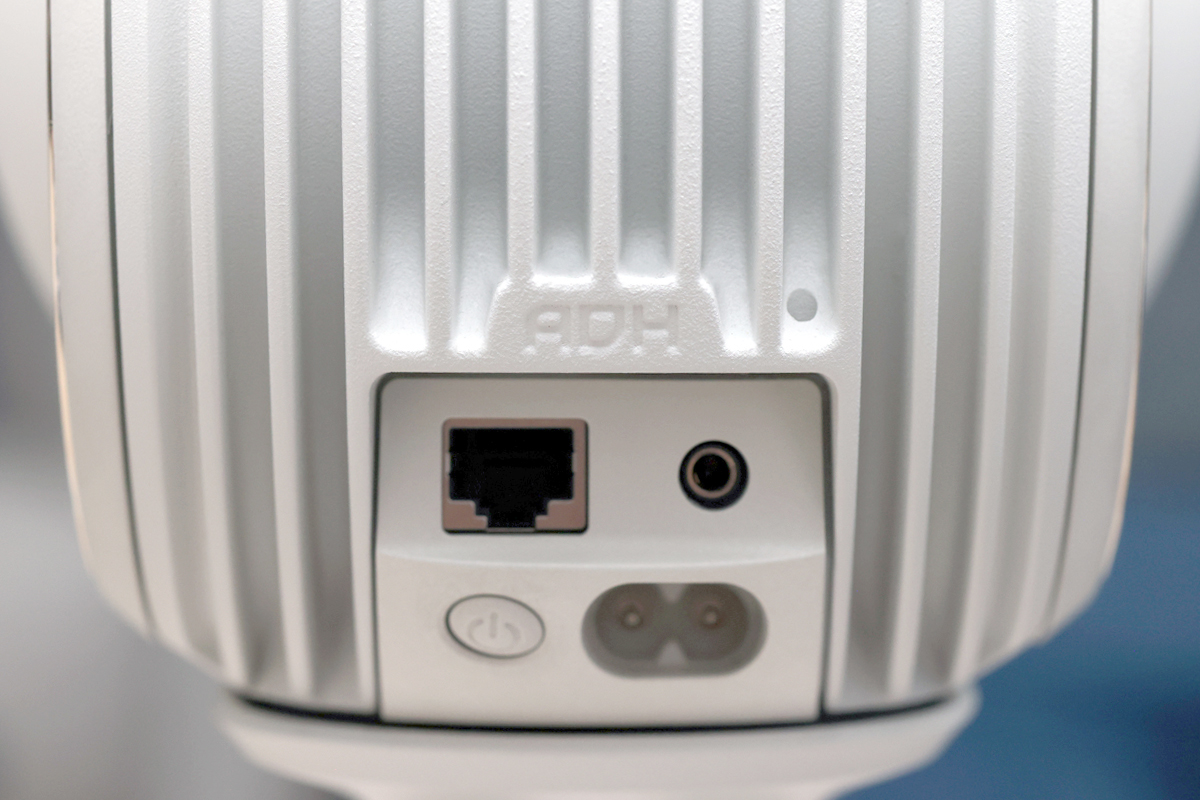
The power button is actually hidden on the speaker’s rear surface, beneath the vertical fins of the speaker’s sizable heatsink, where you’ll also find a two-prong power inlet, an RJ45 ethernet port, and a mini-TosLink optical S/PDIF input. As well as being hidden from sight, the power button, which must be held down continuously to reset the speaker when needed, is quite fiddly. You not only have to press it really far in; you need to press it in just the right way to operate it. It’s unclear why Devialet made pressing the power/reset button so difficult. Unlike on the older Phantom Reactor 900, there’s no analog input available, so it’s also unclear why Devialet opted for a mini-TosLink rather than a standard-sized TosLink port.
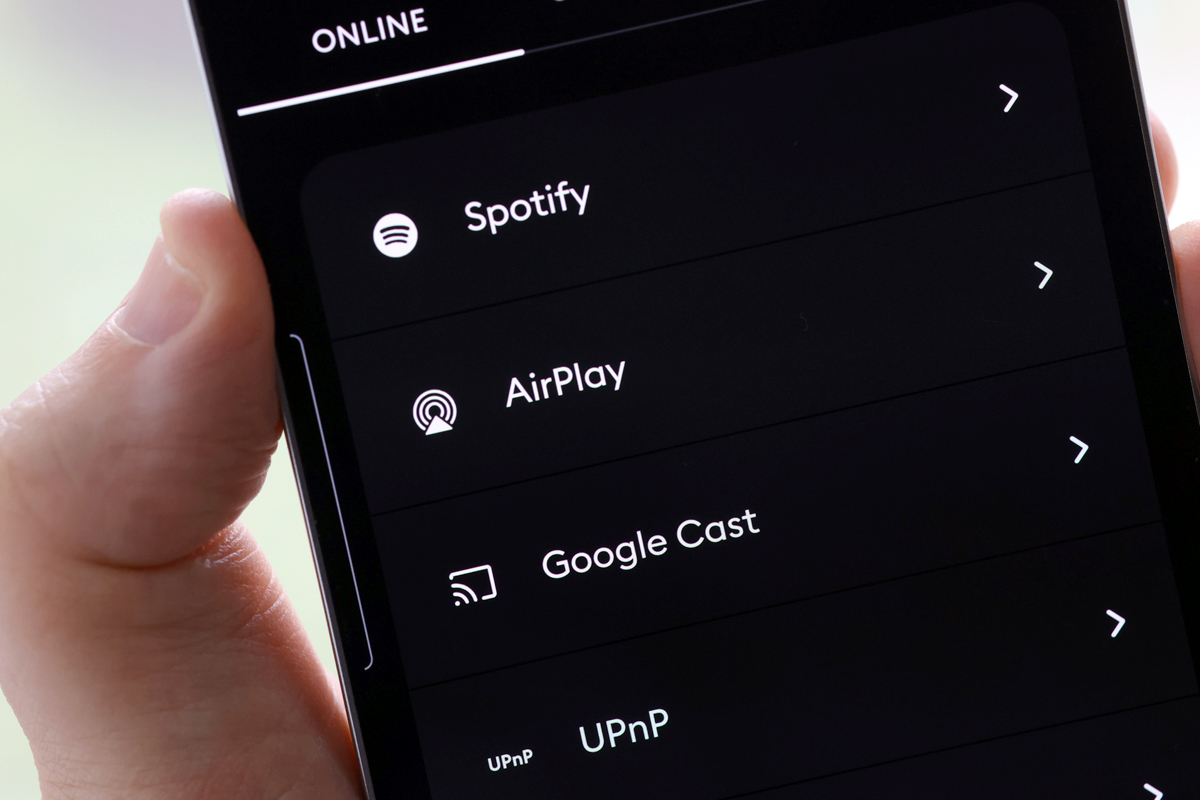
Audio is processed internally at 32-bit/96kHz resolution by an NXP iMX8 processor using the latest Devialet Operating System, DOS 3. The new Phantom relies primarily on wireless connectivity, which is comprehensive and includes Wi‑Fi 5 (2.4GHz and 5GHz bands, 802.11 a/b/g/n/ac), Bluetooth 5.2 with SBC and AAC codecs, AirPlay, Google Cast, Spotify Connect with lossless support, Tidal Connect, UPnP, and Roon Ready certification.
It’s worth mentioning that, in another departure from its lineage, this model does not use HomePlug or powerline (PLC) networking technology for its main network or interspeaker communication functions. Instead, it relies on the more-efficient Wi‑Fi or ethernet, which provide the most robust connection. This is all governed by Devialet’s proprietary DOS 3 sync protocol for synchronization between speakers and music streaming.
A small LED indicator on the top surface provides status feedback without being intrusive. Limited physical controls are available on the speakers themselves, which respond to touch on the top surface for play/pause, volume adjustment, and Bluetooth pairing. For those who prefer more tactile control, the Devialet Remote is available separately for US$199, CA$299, £189, or €189.
Setup
Devialet recommends placing the speaker at least 12″ from the front and side walls and 18″ to 35″ off the floor for optimal performance. The most aesthetically complementary way to achieve this is with the color-matched stand available from Devialet (it refers to the stand as the “Tree”) for US$299, CA$399, £199, or €199 each. Unfortunately, the stand is the weakest part of the package.
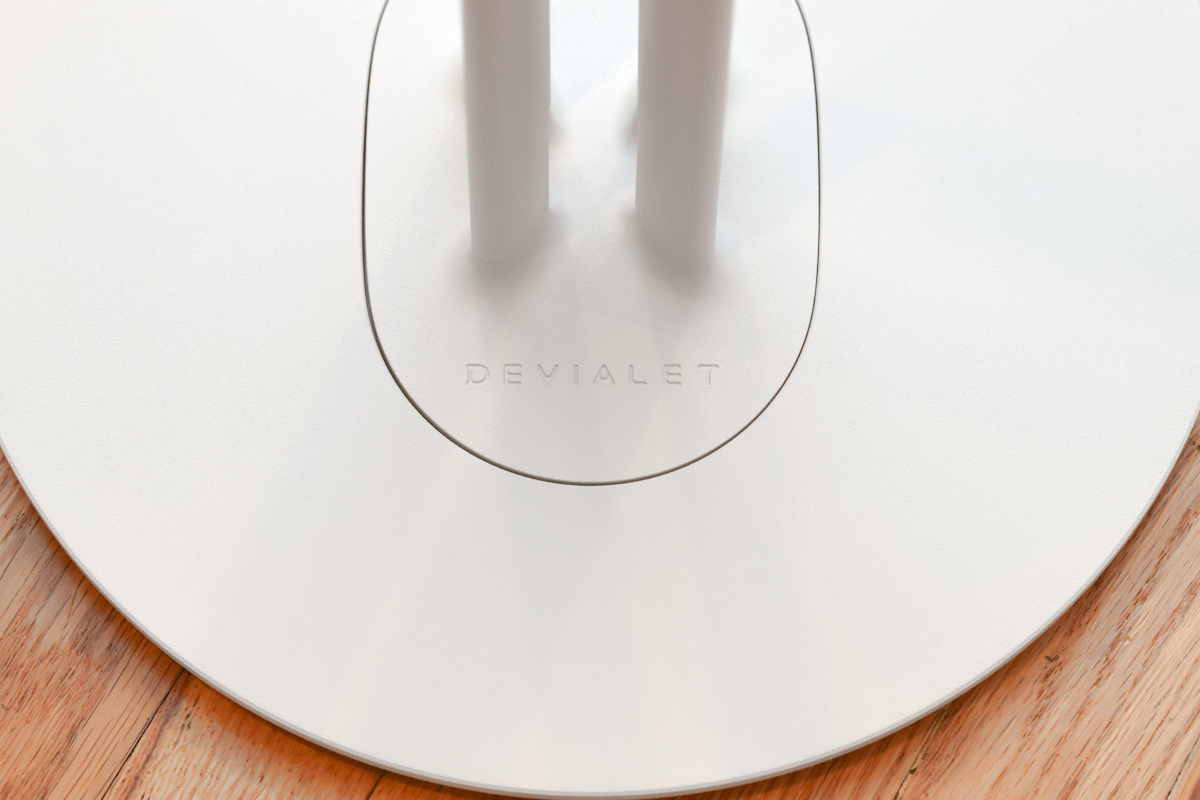
The circular base, 10.25″ in diameter, must be attached to the stand using the four included bolts. This process is complicated by the fact that no tool is provided to tighten the bolts, and I had to rummage through my tool kit to find something that kind of did the trick. There’s no provision made for filling the stand with sand or lead shot, so each 11-pound stand cannot be upgraded in that regard.
Mounting the speaker to this stand involves pushing the Tree’s single captive bolt through the upper platform and into a threaded insert on the speaker’s base, and tightening it using the same (not included) hex key as the one used on the base of the stand. It’s not as straightforward as it sounds, thanks to the awkward angle and location of the through-hole between the two front legs of the stand.
The Trees succeeded in getting the Phantoms off the floor, but at 22″ tall, I found them too short to get the speaker drivers anywhere close to ear level, even for the lowest of armchairs and the slouchiest of postures. Yes, the high-frequency drivers are angled slightly upwards, but I found it odd to hear the stereo soundstage originating from so low down. I experimented with placing the two stands on top of 15″ risers to get the drivers closer to where I wanted them.
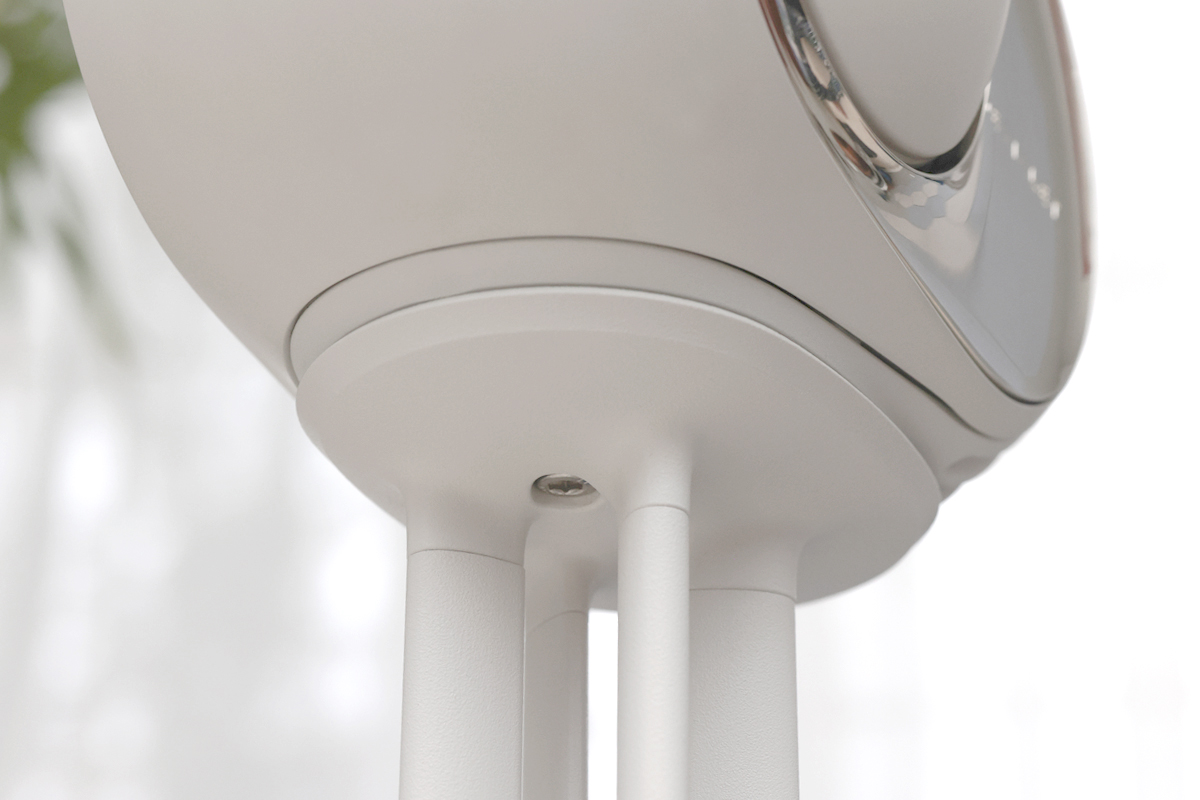
There’s a single clear-plastic cable clamp that mounts to one of the stand’s four legs for cable management, but bafflingly it doesn’t actually accommodate the power cable that’s supplied with each speaker, nor did it fit around the TosLink S/PDIF cable that I used during testing. This led me to wonder: why not provide more than one of these clips, and perhaps make them large enough to accommodate the included power cable?
Initial setup requires the Devialet app, available for iOS and Android. The app (V1.25 tested) is mercifully clean and well-designed. The process is straightforward for the most part: plug the speaker in, power it on, launch the app, click the plus icon to configure the speaker, and enter your Wi‑Fi network credentials. The app then walks you through basic configuration before handing you off to your streaming service of choice. If you’re using two Phantoms for stereo, the app will walk you through the process of creating a stereo pair.
Through setting up the speaker pair at multiple SoundStage! locations, we discovered that this process became complicated when the speakers had previously been set up on another network. This meant having to do a factory reset on both speakers (which necessitates holding down the power button in just the right way). We also found that multiple resets were sometimes needed before the setup process ran as expected.
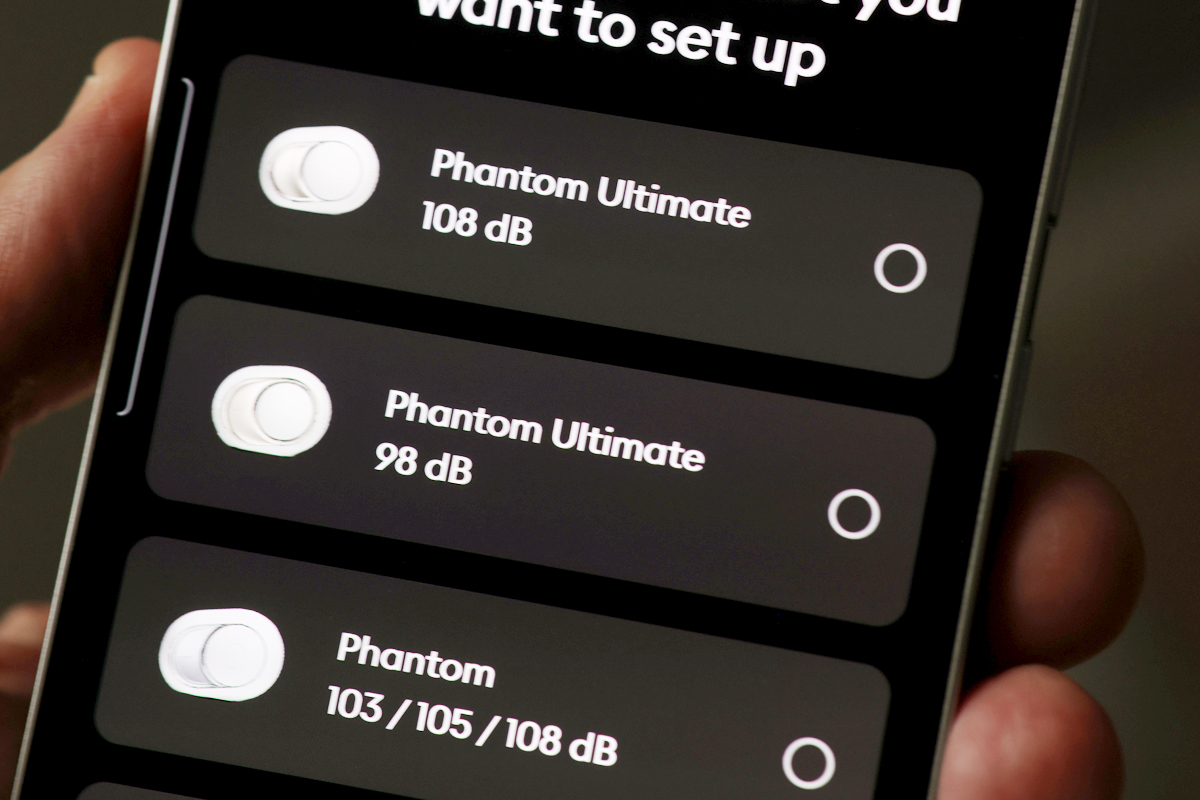
The app includes three listening modes (Movie, Music, and Podcast), a six-band graphic equalizer (±6dB) with presets (Dynamic, Clear, and Soft), and the ability to configure different EQ settings for each listening mode. There is also a monitoring option in the app, which according to Devialet provides a flat acoustic response at 1m, implying that the three standard listening modes all apply some tonal sweetening. You can also create multiroom setups, adjust the stereo balance, and enable a night mode for reduced bass and reduced dynamics. Other features include a bass reducer for sensitive environments and loudness compensation for low-volume listening. In my testing, all these features worked as described and were genuinely useful. There are also standby-power options with variable timing and a helpful latency-control slider.
Wi‑Fi connectivity and synchronization between the two speakers was generally very solid, though on a couple of occasions I did notice the soundstage ducking to one side briefly when one speaker’s data was dropped, perhaps due to network interference. It wasn’t enough of an issue for me to need to connect the speakers via wired ethernet.
The sound
I set up the speakers 6′ apart, each 6′ from the listening position in my 11′ × 8′ acoustically treated den. It didn’t take long for me to appreciate that these speakers mean business. In their default state, the Phantom Ultimates produced a sound that was both larger and more refined than I’d anticipated. By default, the Music setting has loudness compensation enabled and features an elevated sub-bass. It sounded great, and I found the overall tonal balance to be spot on. I liked what I was hearing—a lot. My first observation was that these speakers produce deep, controlled bass that seems improbable given how compact they are.
If you want a track that fools people into thinking there’s a subwoofer hidden somewhere in your room, try the single “Chase (Matthias Tanzmann Remix Extended)” by Giorgio Moroder and Matthias Tanzmann (24‑bit/44.1kHz FLAC, Solaris Records / Spotify). The track opens with a heavy, room-shaking kick drum, which forms part of a four-on-the-floor dance beat, delivered with stunning depth and impact by the Devialets. This remix centers on a rolling bass line that anchors the entire arrangement, paired with crisp hi‑hats and clipped snare hits that create hypnotic momentum as high-frequency percussion elements flitter across the soundstage, all presented with excellent precision. Moroder’s synth motifs appear sporadically, chopped into fragments and dispersed across the mix rather than dominating it, while exercising the full frequency range. The Phantoms presented a tonal balance that I wouldn’t call neutral—perhaps a little “hyped”—sounding both highly engaging and detailed.
The arrangement unfolds gradually, introducing filtered pads and atmospheric sweeps that build tension without overwhelming the rhythmic foundation; this resulted in a wide, immersive, retro-futuristic soundscape between the Phantoms. Tanzmann uses strategic dropout sections where the bass vanishes momentarily, creating negative space that makes its return even more physically impactful. Importantly, woofer control was maintained even with large dynamic fluctuations. There was no port noise (because there are no ports!), no cabinet resonances, and no bloat. Devialet’s Heart Bass Implosion terminology seemed very appropriate here: I could see the movement of the opposing high-excursion woofers clearly from across the room!

The psychedelic-leaning “Push Too Hard” from Astrocolor II (24/44.1 FLAC, Softtone‑Eone Music / Spotify) by Astrocolor, featuring Fox Glove, has swirling organ tones that dominate the harmonic landscape, with the classic swaying modulation of a Leslie speaker. The rhythm section locks into a steady groove, featuring simple bass lines and straightforward drum patterns that support rather than showboat. The Phantom Ultimates, paired in stereo, positioned each instrument precisely across the soundstage. Percussive additions like shakers and tambourines brought texture to the mix without cluttering the rhythmic pocket. Guitars were panned across the stereo field during instrumental sections, creating movement and width that enhanced the psychedelic atmosphere. The vocal melody weaved with good clarity through the instrumental bed rather than sitting on top of it, blending into the overall texture and creating an immersive sonic environment that rewarded repeated listening and attention to detail. I was particularly impressed by the system’s ability to provide serious impact without becoming fatiguing, as quieter moments retained their detail.
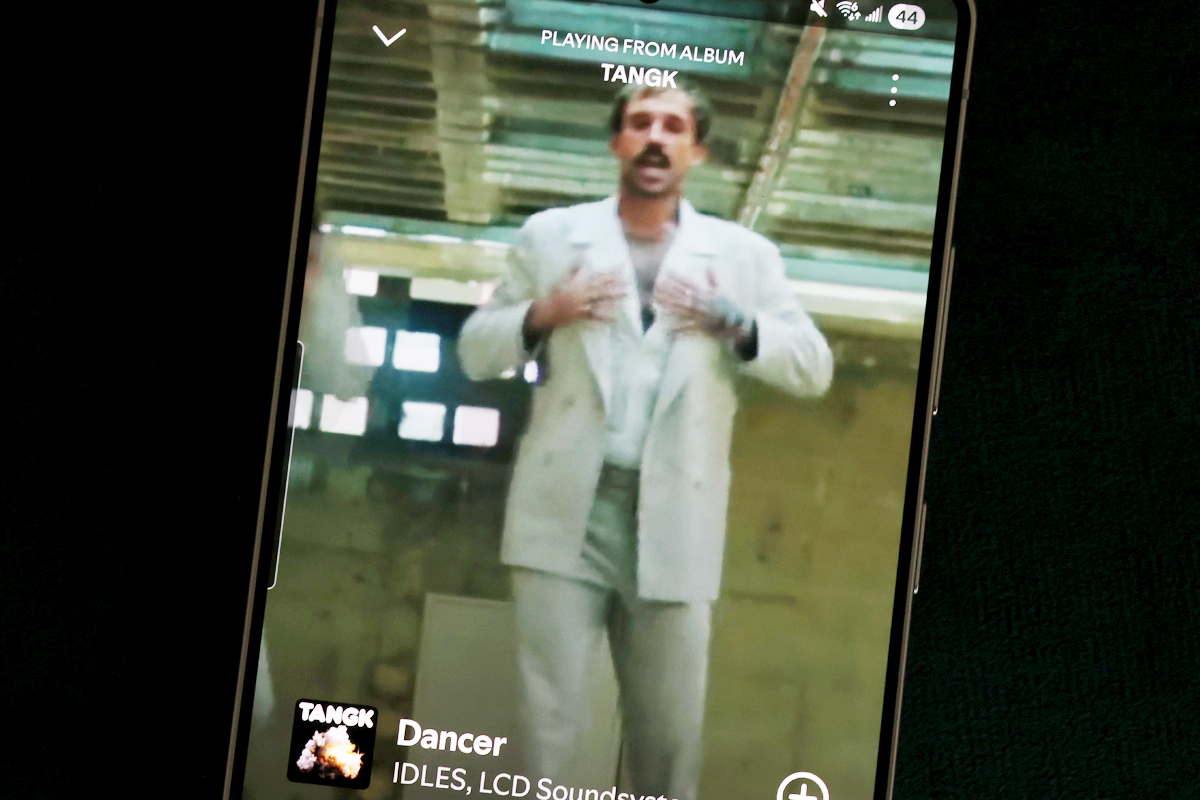
The collaboration “Dancer” from TANGK (24/44.1 FLAC, Partisan Records / Spotify) merges Idles’ punk aggression with LCD Soundsystem’s dance-punk sophistication, resulting in a track built around propulsive, motorik-influenced drumming. Through the Devialets, the kick drum, mixed loud and up front, pounded with metronomic consistency and great impact, powering this heavy track’s propulsion. The crisp transient detail of the Phantoms’ midrange-tweeters conveyed the hi-hats’ constant eighth- and sixteenth-note patterns with palpable urgency and forward motion. Bass guitar and kick lock together on this track, playing repetitive patterns that prioritize groove rather than complexity. That bass tone is mixed huge and (intentionally) distorted, and it sounded both powerful and clear through the Devialets, creating an ominous, emotive drone in (and outside of) my apartment. The low-end presentation was prodigious but always tightly controlled by Devialet’s onboard smarts.
Synthesizer elements brought color without dominating, including arpeggiated lines and pad sounds that filled space between guitar attacks. The arrangement maintains high energy throughout, with minimal dynamic variation, prioritizing dance-floor functionality—which this system brought to life with genuine scale and power.
The Phantoms’ broad stereo width was amply demonstrated by panned guitar parts and synth elements, keeping bass and drums solidly centered for maximum impact. Even at higher volumes, this loud and compressed production didn’t cause the speakers to fall apart, with internal circuits precluding any damage. The woofers executed those dramatic excursions with precision, even at volume levels that would’ve had most bookshelf speakers throwing in the towel. This is smart engineering.
Comparison
For comparison listening, I used my reference KEF R3 Meta bookshelf speakers powered by a pair of Bang & Olufsen ICEpower monoblocks and fed from a FiiO BTA30 Pro DAC (outputting an optical signal simultaneously to one of the Devialets), with Spotify running on my MacBook Pro as my USB digital source. Each R3 Meta employs a 6.5″ hybrid-aluminum woofer, larger than the woofers used in the Phantom system—but each Phantom has a pair of those sealed, active woofers with the combined midrange-tweeter in between. The KEF R3 Meta differs in that it is a passive three-way design with a larger, concentric mid-and-tweeter array, and it employs a significantly larger enclosure that is bass-reflex loaded. I carefully level-matched the systems using a pink-noise track at -10dBFS to give me 70dB between the speakers, measured using the NIOSH SLM app on my iPhone.
It was immediately clear that the KEF speakers simply couldn’t compete with the Phantoms’ extraordinary bass extension or output. To level the playing field somewhat, I connected my Rythmik Audio 12″ Direct Servo subwoofer to augment the KEF system, with an 80Hz crossover, and repeated the level-matching process.
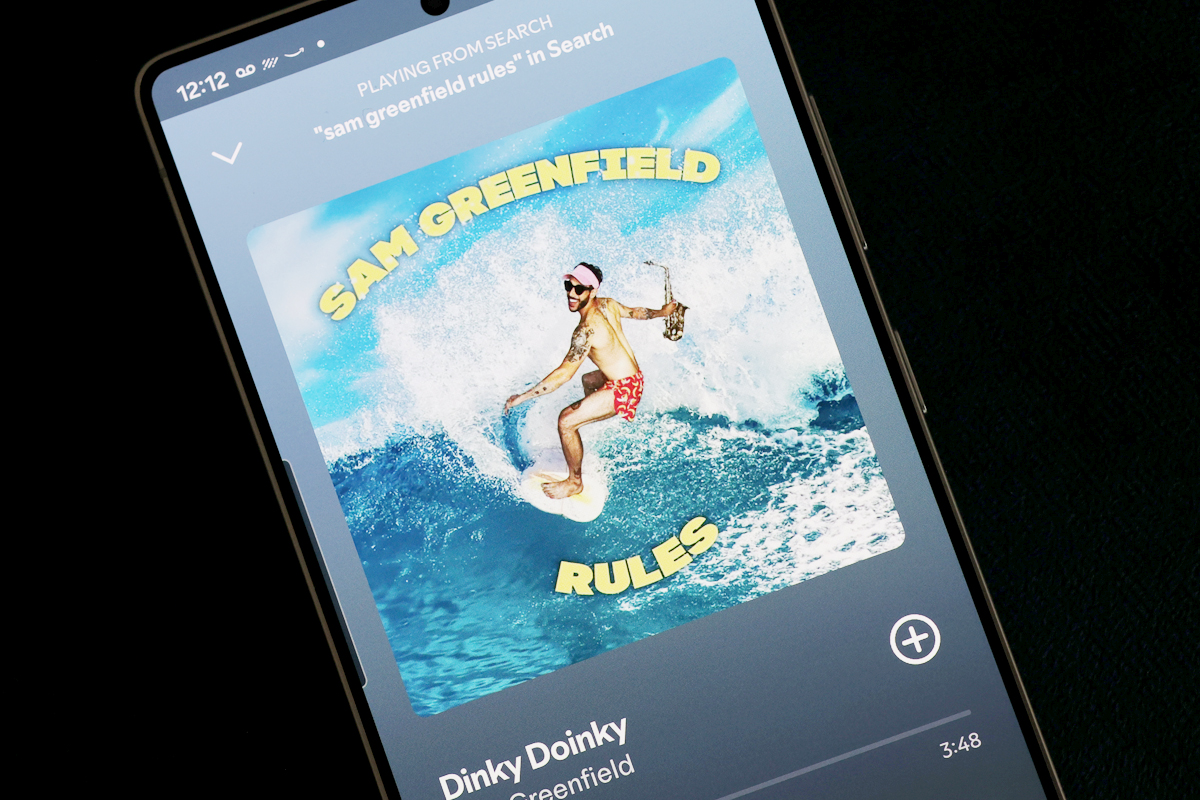
With this setup, I found there were notable differences in the presentation between the two systems. For example, the funky, synchronized sax-and-keys riff of the quirky instrumental “Dinky Doinky” from Sam Greenfield Rules (24/44.1 FLAC, ONErpm / Spotify) revealed that midrange textures like the throaty growl of the saxophone were more tangible on the KEF R3 Meta and Rythmik sub combo. A light upright bass walks through simple root notes, providing just enough harmonic grounding without weighing down the arrangement’s buoyant character, which conversely was presented more articulately through the Devialets than the KEFs. Through the Phantoms, the upright bass had genuine weight and texture, notes blooming and decaying naturally. Dynamics in the track shift as the density of the instrumentation changes, keeping every element crisp and articulate; rhythmic figures landed with impact on both systems, though the Phantoms won me over with their precision in rendering dynamic passages.
I also noticed textural differences in the violins in Emancipator’s “Rattlesnakes” from Safe in the Steep Cliffs (24/44.1 FLAC, Loci Records / Spotify), where the KEF speakers’ midrange revealed a little more of the stringed instruments’ tonal character. Through the KEFs, the violins sounded more natural, not overly bright or thin.
The rest of the track is built around a foundation of organic and electronic elements that blurs boundaries between live instrumentation and sample manipulation. Layered beneath are electronic bass tones that pulse with trip-hop weight, and I found that these deep frequencies merged more organically with the midrange on the more tightly integrated Devialets. The Phantoms did a better job of delivering a multisensory experience that felt like going on a journey, bringing ample bass weight combined with imaging precision to the elements that moved through the soundstage.
Conclusion
Devialet says its Phantom Ultimate speaker system is effective in single-unit, stereo, and multichannel configurations. As I pointed out at the top of this review, if you want stereo, you need two, so a stereo pair represents a total outlay of US$3800 (without stands). That’s enough to purchase some excellent conventional passive speakers and amplification. While it’s worth acknowledging that you’re paying a premium for the look and the brand (the Phantoms do have wow-factor design and a specific aesthetic appeal), they justify the asking price on sonic grounds alone.
Like all Phantom speakers, the Ultimate 98 dB looks like a prop from a science-fiction film, so there’s no middle ground with this design. This is a speaker for the person who might choose Bang & Olufsen not just for sound quality but for how the equipment makes them feel. It’s for the music lover who wants something that sounds considerably better than a smart speaker but doesn’t want to deal with separate components.
After several weeks of listening in my home, I can say this: Devialet has created something quite special and genuinely different. The review pair of Phantom Ultimate 98 dBs could play louder and dig deeper than anything else I’ve ever heard in such a compact format. I found these speakers to represent my personal holy-grail combination of unobtrusiveness, ease of use, and sonic precision.
The Devialet Phantom Ultimate 98 dB system produces genuinely impressive sound from a compact package, offers reliable wireless connectivity, and provides a user experience that is generally well-executed (though the setup process could use some refinement). The build quality is exemplary, the technology is sophisticated, and the bass output in particular punches well beyond the speaker’s size and weight class. All I can add is that I was very sad to say goodbye to these French active speakers.
. . . AJ Wykes
Associated Equipment
- Sources: Apple MacBook Pro (2019), iPhone 15
- DAC: FiiO BTA30 Pro
- Speakers: KEF R3 Meta
- Power amplifier: Bang & Olufsen ICEpower monoblocks
- Subwoofer: Rythmik Audio 12″ Direct Servo
Devialet Phantom Ultimate 98 dB streaming active loudspeaker system
Price: US$1900, CA$2400, £1400, €1500 each in standard finishes; matching “Tree” stand available for US$299, CA$399, £199, €199 each
Warranty: Two years, parts and labor
Devialet
SAS 10, Place Vendôme
Paris 1ER
France
Website: www.devialet.com